The Digital Sales Funnel

Digital marketers often refer to the marketing funnel by different names, such as the purchasing funnel or sales funnel. Regardless of the terminology used, this tool is essential in any marketing plan as it helps define user journeys and connect marketing and sales activities.  (Wikipedia definition for reference),

Defining the Marketing Funnel

According to YourBusiness, a marketing funnel is a system that tracks the stages consumers travel through to reach a buying or target decision. In other words, it maps out the user journey along your marketing and sales process. Understanding the marketing funnel and its different stages is crucial for effectively monitoring and optimizing your campaigns.

Below we are consolidating some of the most common funnels, drafting a list of general steps for each of them and adding some comments about the Digital Transformation challenges Digital Marketers and Analytics teams may face on ROI tracking and monitoring activities

Different Industries, Different Funnels

Funnels vary across industries based on the purchase decision process and the available user journeys. Each industry and market has its specific funnel, which affects the costs and conversion rates at each stage. It is important for digital marketers to understand these funnels to connect traffic to specific actions, monitor performance, and define optimization processes.

On this list we are presenting a first list of the most common journeys we will face. Each industry and market have different number of steps which will affect the costs (CPI, CPC, CPA) and to the conversion rates along the journey.

Let’s Explore Some Digital Marketing Funnels Across Different Industries

  1. Leads generation and Online to offline funnels

Education, construction, automobile, health and care, financial services and other high-value service industries often utilize online-offline funnels that generate leads, specially in B2B businesses. The key step in these funnels is how to convert engagements into leads at a profitable price. Digital marketing goals usually revolve around driving traffic to specific landing pages through content, competitions, discounts or white papers in order to pipe those  users into registrations or leads. To optimize these funnels, consider leveraging lead tracking and management systems, to be able to map new sales to the sales channel that generated it. If you are able to track the piece of content that generated the engagement, you will be able to generate insights that can be used by your content development team to optimise CTA and  improve your  branding campaigns support to sales. You can learn more about attribution on this other article – Attribution, a key concept (…).

Education, construction, automobile, health & care and other high value services industries that require consulting tend to use this funnel, where “leads generation” is the key step.  You may find this funnel labelled as D2D (direct to distribution).

    1. The digital marketing goals is usually to generate registrations (leads) by driving traffic (impressions + clicks) to specific landing pages
    2. The leads database is transferred to distribution teams (sales departments, partners) generally via CRM/ERP. The distribution teams may receive these leads in specific Aps or back-end systems.
    3. Teams in charge of manage leads (Telesales dept, Agents or re-sellers) will try to arrange consultation meetings (can be online but offline are more popular). CRM-ERP should be used to track the number of calls, lead status, etc.
    4. Ideally the systems in charge of handling the leads to the Sales Team should send back the management info to the CRM/ERP for monitoring processes.
    5. Afterwards, users can be re-approached with re-targeting campaigns through different channels: SMS or E-Mail marketing, etc..

Example: The education industry in Thailand and Vietnam has an average CPL – cost per lead (user registration) of 8 – 6 USD and an average CR of 3% to 10% depending of the channels.

funnel 1
Common in companies that need personal consultation: Real State, Auto, Education, etc…\

Digital Transformation effort to track & optimize: These funnels are perhaps the hardest one to monitor and track ROI (Return on investment) since require the consolidation of off-line & online data sources. Moreover, we will require to ‘capture’ and ‘carry out’ IDs from our external touchpoints when the lead or interest confirmation is submitted in our touchpoint.

Those business that have to differentiate among their customers VS non-customers for compliance purposes – financial industry players (Banks, Insurances, …) will need to add another layer of complexity.

2. Brand support focused funnels: Online and one way communication funnels. 

A large amount of companies focus their Marketing activities on promoting their brands only, since final sales are outsourced to other retailers. This is a very typical example of Fast Movement Consumer Goods (FMCG) companies (like Unilever, Coca-Cola, Nestlé, Heineken), Apparel (Nike,….), Film Industry (Paramount, Universal), etc,  Their key characteristic is that they do not have their own point of sales and rely on third party retailers (shops, cinemas, …) their campaigns often focus on branding only:  generating impressions and engagement without unit sales targets.  These funnels rely heavily on captivating content, influencers, targeted communication plans and trends adoptions, to generate demand and push customers to locate the closest retailer they can find. Tracking these funnels is relatively simpler since sales tracking is rarely required. If it is, the mother company will have to integrate with their retailers, which is becoming more and more common. In overall for this funnel:

    • Marketing plans are based mostly on communication plans to introduce products, trends or promotions.
    • On-line communication materials that use influencers, connecting and inspiring with target audiences. Tone, channels and messages must be consistent among time and usually take longer time to reflect on sales.
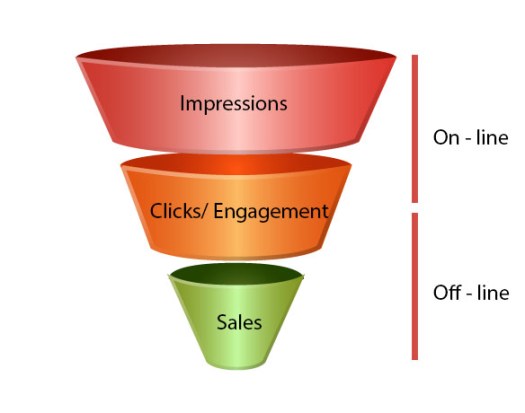
      Funnel 2

        FMCG Funnel – Companies like Unilever, Nestle or L’Oreal tend to use this funnel on their branding campaigns

3. Direct Sales Oriented Funnels

Industries such as airlines, B2C retailers, NGOs/crowdfunding, retailers, professional services or entertainment companies  – tourists packs, Streaming services, adults content and others – are capable to implement a 100% online purchasing focused on driving direct sales.

    •  Digital marketing plans for these industries often aim to drive traffic to purchase product pages, distributor contact pages, or custom research landing pages. (Ex: Lazada Thailand), distributors contact page  (EX: Alibaba Thailand) or to custom researches focus on drive traffic to landing pages where where people move from seeing to buying.
    • Leads generation may also be included in these funnels. Tracking these funnels is generally simpler since the entire process occurs online.
    • Considerations such as cancellations, wrong orders, and stock depletion need to be accounted for to ensure accurate tracking and optimization.
    • Example: USD crowdfunding  pages have an average CR of 1.5% (Wedidit source)
    • amazonAmazon, Lazada and big E-commer portals hold a 100% online funnel

      Digital Transformation effort to track & optimize: These processes are usually simpler to track (from Digital Transformation perspective) since the whole funnel occurs online.

      Nevertheless tracking and optimization processes will have to consider events like ‘cancellation’, ‘wrong orders’ or ‘stock depletion’ or other reasons that may force your business to cancel the order. Once that happens, we’ll be forced to review some of the “sales” counted that need to be reviewed.

      Tracking processes of current customers should be easier than those for non-customers, since full online provides may store most of the info needed for future transactions on their ‘Customer profiles’ after they sign-up/

4. Mobile Marketing Funnels: Mobile marketing plans for apps or music services primarily focus on app installs and maintaining active users. These funnels require driving traffic to specific landing pages or app store pages for installations. Keeping users engaged and active is crucial, and inbound marketing plays a significant role in achieving this. Mobile funnels tend to be larger and more challenging to maintain.

    • Digital activities focused on drive traffic to specific landing pages or straight ahead to App’s stores pages (iTunes or Google Play install page)
    • This funnel is longer than usually as you have an extra step: Keep your users active. For this channel is extremely important to provide constant value through Inbound Marketing to keep your community active

      mobile funnel
      Mobile Funnels are the largest and hardest to maintain funnels
  • Monitoring the average cost per install closely is essential, as performance can vary based on location and segments. The e-commerce industry in Thailand and Vietnam is around 1 USD and the CR is around 10%, whereas in developing countries, that prices rises to 40 to 50% more Memeapp cho Phien source

A good example of good mobile funnels is Trip Advisor.

Trip advisor follow their users based on their GPS location and recent researches. When they see that users have moved to other city and have looked for restaurants on the app, they re-approach requesting for reviews. Moreover, they deliver custom reports of how many people viewed their reviews
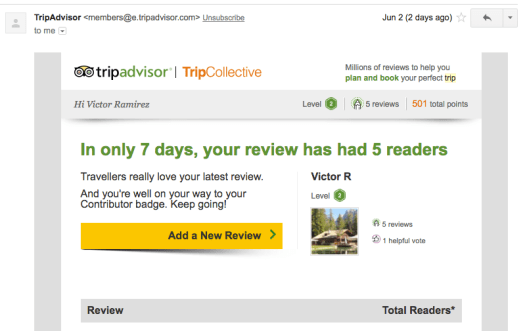
Screen Shot 2016-06-04 at 3.29.46 PM
Trip Advisor actively encourage users to icrease the weekly / monthly open rates with dedicated E-Mail Marketing Campaigns

Digital Transformation effort to track & optimize: These funnels are usually complex since:

Mobile App implementations are always more difficult that Web implementations and will require tailor solutions for Android and iOS, whereas in Web a single solution is easier to reuse.

The app installation may not be the final objective of the investment and other journeys completion may be required.

To sum up

… understanding marketing funnels is crucial for marketers across any industry. By leveraging industry-specific enhancements, such as advanced lead management systems, personalized remarketing, data integration, and mobile optimization strategies, marketers can optimize each level of the user journey and drive better results. Stay informed about emerging trends, conduct thorough research, and adapt your strategies to ever-evolving customer behaviors for continued success.”

User creation and activation may require extra activities like ‘user registration’ or ‘OTP confirmation’ that will increase the complexity of the technical set up.

Overall, the marketing funnel is one of these concepts that every marketer should understand at high level, not only within their industry but also on other third industries.

This knowledge can bring marketers to better partnerships, variants and combinations to optimize each level of the user journey

Facebook & Google In-House Ads Accounts: How to improve media buying Transparency

During the last weeks I had to explain this issue several times, so I realized I should write a new Blog post to save time in future meetings 😀

With this article I pretend to introduce the big value that in-house accounts can provide to every small and medium company. Overall it will help to:

  • Increase transparency
  • Maximize investment
  • Boost performance.

I will based my article on the Facebook and Google accounts as these two ads platforms allow you to invest in media on Facebook, Instagram, Google Search, YouTube, G-Mail, Maps and GDN however we can extend this to any other traffic / media buying platform that offers a client panel.

Ok…. So, what is the problem? Why is there an overpricing on Facebook and Google media purchases? How is the current situation?

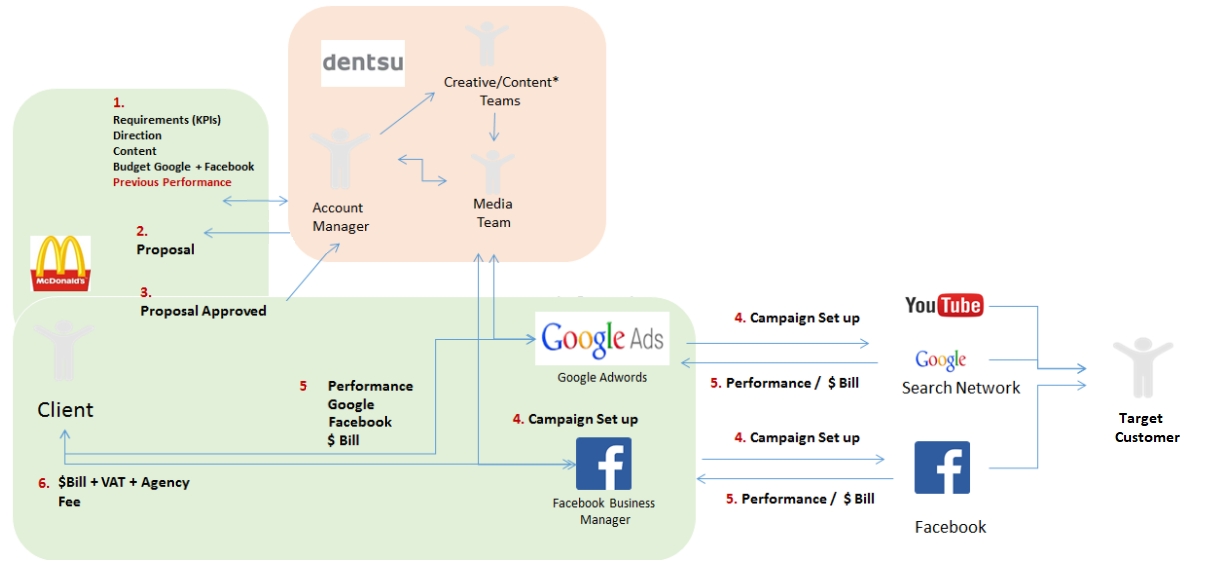
The chart below could be a good intro of the scenario. Let me go step by step:

Blog Visuals

Agency Accounts management

Let’s say that Mc. Donald’s has a brand new product that wants to boost and asks their Digital Agency (lets say…. Ogilvy, Leo Burnett, Dentsu or other digital group) to run a campaign in Facebook, YouTube and Facebook. For the example I will chose Dentsu due to the recent scandal commented to by the Financial Times they had in Japan for similar practices.

Long story short, the key problems starts when the Vendor proposal doesn’t provide:

  • Final performance of Clicks (CPC) / Engagements (Cos per engagement) gaps* based on Facebook/Google Ads estimations or variable costs. Instead of that, Vendors tend to propose fix Unit Cost (cost per click, cost per engagement, etc…) that most of the times are three to four times higher than they are actually paying to Facebook on average.
  • Access to the client to their Facebook / Google Ads accounts
  • Support to their clients to create their own accounts

At this point, some of you may think:

  1. Why should they provide a gap? – Most of the big digital publishers (Facebook, Google, Yahoo!…. do not have fix pricing lists but complex bidding systems (click her for further info)
  2. Why they bill 3-4 times the price they pay to Google/Facebook?

I may be defending the devil but it is true that there are several reasons to behave in that way like:

  • As a back-up in case they fail in their estimation.
  • As a back-up to spend less time in optimization/set ups.
  • Media budgets are usually 20% – 50% of the total costs. Big agencies charge big fees in creativity and content direction that cover media overspending.
  • To earn more money – Good agencies. Good optimization teams master their jobs in order to boost the gap from the ‘Unit Cost’ accepted by the client and the price they finally pay to the publishers
  • To ease quotations and boost long term plans.

Given this point, the agency (usually) finishes the quotation with a unit cost a way higher than the market price.

  • The agency delivers a proposal:
  • The Client approves: Let’s go!
  • The Agency uses their own accounts to work with the publishers:
  • Facebook Business Manager Account to pay Facebook for Facebook ads, Instagram Ads, etc…
  • Google Adwords Account to pay Google for ‘Google Search Network, GDN, YouTube Ads, etc…

Facebook and Google deliver ‘performance report’ and ‘bills’ (this is the key) to the Agency, not the client. Afterwards the Agency sends back the invoice but they (almost never) include the Facebook or Google Invoice…. In other words… The client has no clue of how much money the agency paid for the services!!!!

This is a big problem because Mc. Donald’s actually cannot request Facebook how much money the agency spent on the campaign:

  • Facebook client is Dentsu, not Mc. Donalds’s.
  • Facebook has no liability of giving any explanation to Mc. Donald’s.
  • Facebook is not allowed to display any data of Dentsu account without their approval.

Damnnn, how can Mc. Donald’s solve this issue:

Ask Dentsu to grant you access to their account: agencies may reject this option claiming that these accounts have data of other clients they do not want to share

In-house accounts.

By having in-house accounts Clients get the full control of how much money is spent in Facebook. Given this point, Clients have two options to run campaigns:

  1. Let the Agency use their account: By granting advertising permissions to the agencies, Clients can monitor the performance and the budget spent by the vendors. On top of that, they can access to the detailed performance information and develop digital know-how of the industry for future plans
  2. 100% In-house campaigns: Clients can run campaigns by themselves without agency intermediaries, which usually saves the ‘agency fees’ plus the VAT costs. Recommended only if the ‘head of digital’ has a strong background and extended experience

Attribution, a concept that may save you when you need it the most!

Digital agencies, heads of digital marketing, and performance teams often grapple with a challenging question: ‘Why do we continue investing in Channel A or Channel B if they are not profitable?’ This article aims to offer clarity and guidance on this matter by delving into the concept of attribution and its crucial role in measuring the effectiveness of various marketing channels.

The Importance of Attribution: Attribution is the scientific method of assigning values to individual digital touchpoints throughout the customer journey, starting from the initial interaction with your brand or product and extending to the final purchase along the marketing funnel. It enables you to accurately assess the impact of each channel and activity along your marketing or sales funnel. Proper attribution not only optimizes marketing  funnel and campaigns but also provides valuable insights into the actual return on investment (ROI) of each channel, making it a crucial factor to consider during budget allocation reviews. The article ‘Rethinking today’s attribution problem in digital marketing ‘ would serve as an excellent supplementary resource.

Exploring Attribution Models: There are various attribution models that exist, each designed to distribute conversion credit in different ways. By understanding these models, you can gain a deeper insight into the effectiveness of your marketing efforts and make well-informed decisions. Let’s delve into some of the most popular attribution models.

attribution models

  1. First Click: This model attributes credit to the channels that initiate the customer journey, including first-click channels such as Facebook posts, GDN banners, organic search visits, and email marketing activities. Comparing the results of the First Click model with the Last Click model can be powerful as it allows you to optimize your content and visuals based on their respective contributions
  2. Last Click: The Last Click model is the most common attribution model. However, it carries certain risks as it tends to overlook the significance of the first interaction. It’s important to remember that most users interact with your brand multiple times before converting, making the first interactions crucial. Relying solely on the Last Click model may result in disregarding the top-of-funnel channels, potentially hindering the effectiveness of your remarketing efforts.
  3. Last Non-Direct Click: This model addresses two requisites. Firstly, it ignores direct traffic and considers only organic, referral, paid, social, and other sources. By filtering out direct traffic, which typically comes from existing customers, employees, or common users acquired through a different channel, you can focus on the last marketing activity before conversion. Secondly, it ignores the second-to-last click, giving more credit to the referring channel by disregarding the click immediately preceding the final conversion.
  4. Linear Model: In the Linear model, equal credit is assigned to every channel involved in the conversion. This approach ensures that all touchpoints along the customer journey receive acknowledgment for their contributions.

By relying solely on the last-click model, you may unintentionally overlook the early, top-of-funnel activities that play a crucial role in driving customer engagement and awareness. Focusing only on bottom-of-funnel elements like branded search and remarketing, which tend to drive the final conversion, disregards the value and impact of the channels that contribute to the initial stages of the customer journey. Neglecting the significance of top-of-funnel channels can lead to diminishing returns on your remarketing efforts over time.

If you have more questions, feel free to visit this  Google Support link that elaborates further these points.

 Why is it important to consider attribution models beyond the ‘First’ and ‘Last’ click interactions?

While models like time-decay and metric-driven attribution offer more sophisticated approaches, they still have limitations. These models may assign arbitrary values and fail to account for gaps when customers switch between channels, particularly in cases where the transition occurs from online to offline interactions.

To gain a comprehensive understanding of your marketing efforts, it is essential to explore various attribution models and choose one that aligns with your specific business goals and customer behavior patterns. This holistic approach allows you to capture the value of each touchpoint along the customer journey, optimize your marketing strategies, and drive long-term success.

Remember, attribution models should be regularly reviewed, refined, and adapted to ensure they accurately reflect your evolving marketing landscape and customer preferences.

Conclusion: By understanding and leveraging attribution models, digital marketers can gain valuable insights into the effectiveness of different marketing channels throughout the customer journey. This understanding helps optimize campaigns, allocate budgets more effectively, and unlock the true potential of your marketing efforts.

Remember, attribution is an ongoing process that requires continuous refinement and adaptation to your specific business goals and cu

Why is it important to consider attribution models beyond the ‘First’ and ‘Last’ click interactions?

While models like time-decay and metric-driven attribution offer more sophisticated approaches, they still have limitations. These models may assign arbitrary values and fail to account for gaps when customers switch between channels, particularly in cases where the transition occurs from online to offline interactions.

To gain a comprehensive understanding of your marketing efforts, it is essential to explore various attribution models and choose one that aligns with your specific business goals and customer behavior patterns. This holistic approach allows you to capture the value of each touchpoint along the customer journey, optimize your marketing strategies, and drive long-term success.

Remember, attribution models should be regularly reviewed, refined, and adapted to ensure they accurately reflect your evolving marketing landscape and customer preferences.

Conclusion: By understanding and leveraging attribution models, digital marketers can gain valuable insights into the effectiveness of different marketing channels throughout the customer journey. This understanding helps optimize campaigns, allocate budgets more effectively, and unlock the true potential of your marketing efforts.

Remember, attribution is an ongoing process that requires continuous refinement and adaptation to your specific business goals and customer behaviors. By embracing attribution, you can make more informed decisions, maximize ROI, and drive long-term success.”

By embracing attribution, you can make more informed decisions, maximize ROI, and

Related articles you may enjoy:

  • What’s the best attribution model For PPC? –
  • Attribution modeling overview – Link
  • Guide to Google Analytics Attribution Models – Link
  • Understanding View-Through Attribution – Link

https://platform.linkedin.com/badges/js/profile.js