GEO/AEO/LLMO, the new players in Digital Acquisition that will take the throne of SEO and no digital business can overlook.

Until very recently, SEO (Search Engine Optimization) was the king channel for most businesses to drive traffic, leads, and brand visibility at a scalable cost/sale through organic rankings. But with the rise of ChatGPT and the new wave of AIs, the digital acquisition landscape has been transformed. Google itself has changed how “search” works, shifting from classic SERPs to Gemini’s AI Overviews (SGE). At the same time, millions of users no longer “Google it” but instead ask ChatGPT, Gemini, or Perplexity for direct answers—getting immediate, synthesized responses, often at the expense of traditional clicks.
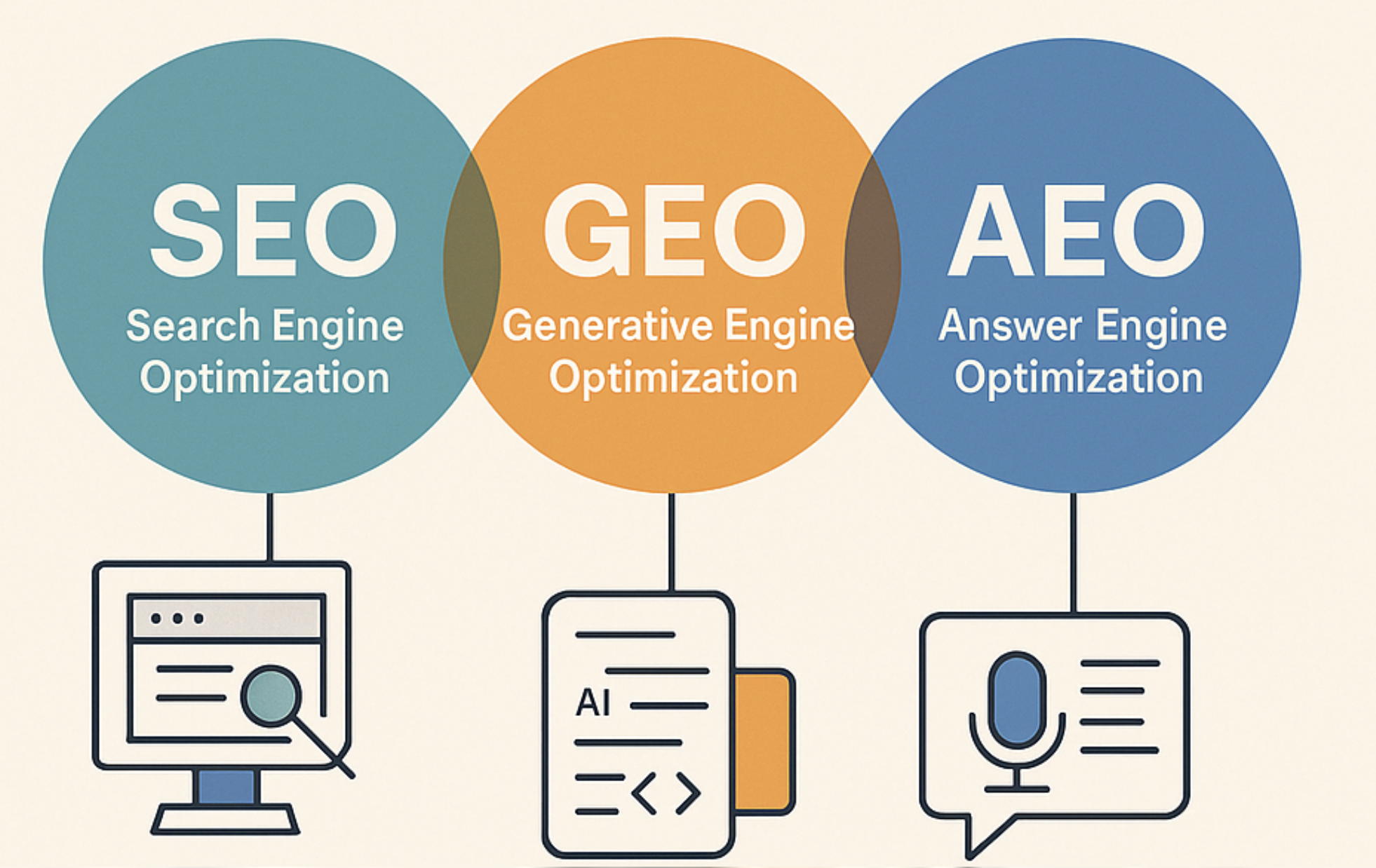
The Consequence for Digital Businesses.

If you are running a digital business or digital marketing channels are key to your regular income, this isn’t a minor shift. AI Overviews are estimated to generate organic traffic reduction by 15%–60%, depending on the industry and query type as this Forbes article ‘How AI Search Is Draining Your Traffic‘ . Organic visits fell from over 2.3B to under 1.7B in a single year, while zero-click searches jumped from 56% to 69% (Wikipedia). Smaller sites without strong domain authority are often hit the hardest. Some examples of must-read articles anybody interested on the topic should go for:

  • MailOnline saw CTRs plunge by 56% even when ranking #1 as detailed on ‘New data: Google AI Overviews are hurting click-through rates’ from Search Engine Land.
  • According to Search Engine Land, informational queries featuring AI Overviews report CTR drops of 15–35% (from the same Search Engine Land article).
  • E-commerce brands reports how different eCommerce sites owners have seen overnight 40% traffic losses when AI answers replaced traditional clicks on a bit pessimistic article from Passionfruit ‘Your E-commerce Site is About to Go Invisible. The Fix is Generative Engine Optimization.‘, but that I do encourage to go through as it explains very well why the traditional keywords strategies are dead since AI’s do not match keywords but understands its intent.

What about if I am a publisher, how Big Is the Impact?

According to the latest NY Post report, News publishers lost over 600M visits a year. If you have a publisher or work in one, this article is also a must-have. ‘Media Google AI summaries increase frequency of ‘zero clicks’ to search results, sinking traffic to news sites‘, where it is explained how people are starting to stop visiting blogs or newspapers to find information in articles but ask AI’s where the info is, and a much faster pace than expected.

AI is already generating a huge impact on publishers, advertising networks and digital marketing channels in general, since a large amount of the WWW traffic will be absorbed by AIs…. and this is just the beginning!

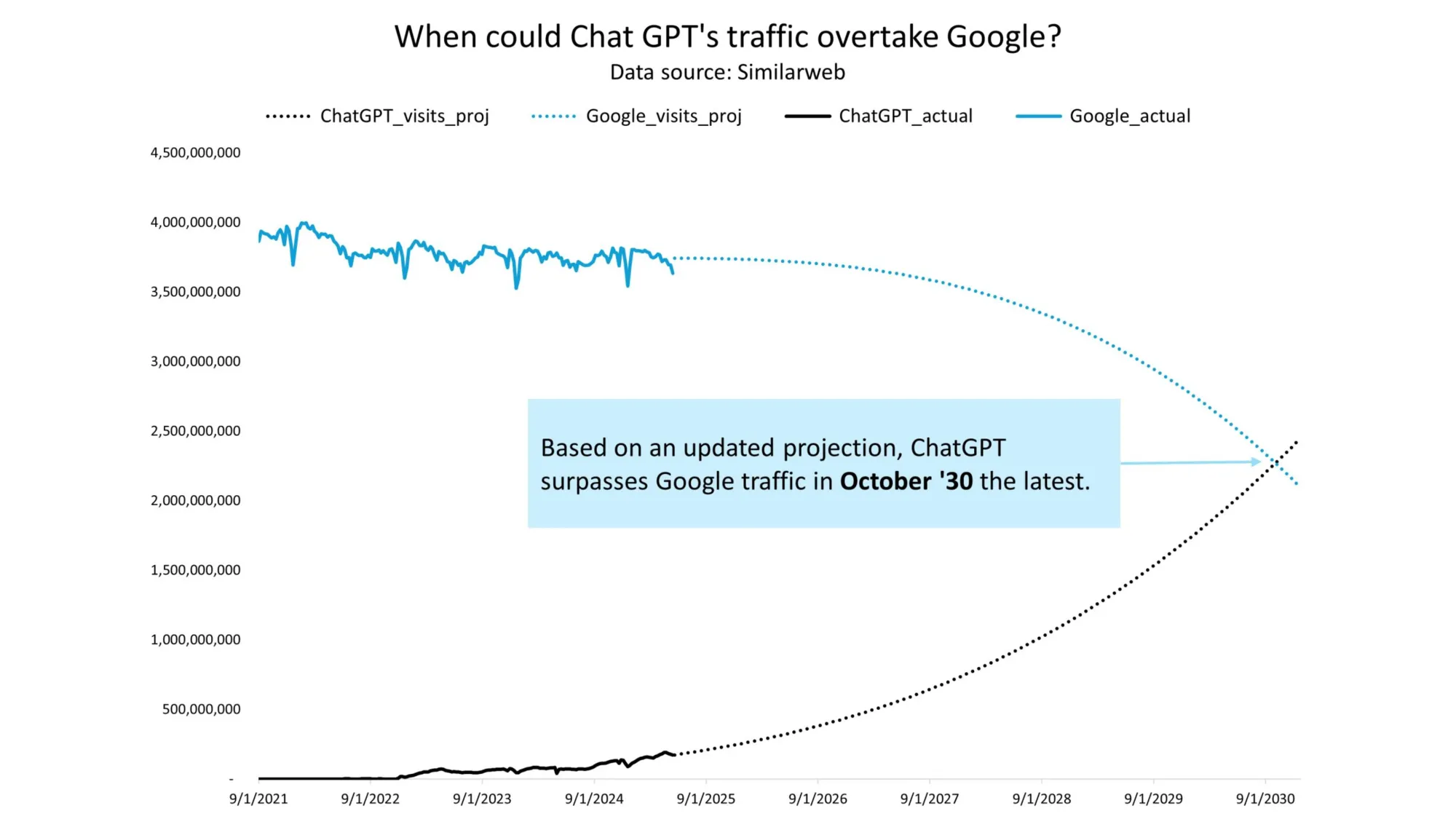
How long will we need to wait? Not much! According to Similar Web, we may have already seen the maximum volume of traffic in the internet and visits may be decreasing in favor of AI searches, which may meet by (or even before) 2030.
Ok, But What Does GEO Mean? And What Are AEO, LLMO and All These New Terms?

This sounds exciting and perhaps a bit scary, but let’s take a step back and be sure we understand the key concepts of these revolutions:

  • SEO: It is the process that aims to optimise content to rank a page or a site as higher as possible in traditional search results via keywords, backlinks, and technical performance.
  • GEO (Generative Engine Optimization): process or strategy of optimizing digital content specifically for generative AI engines and platforms like ChatGPT, Google Gemini, and Microsoft Copilot. Unlike traditional SEO, which focuses on getting clicks by ranking on a SERP, the goal of GEO is to have your content be the source that a generative AI selects and cites directly in its answer to a user’s query.
  • AEO (Answer Engine Optimisation): AEO is the practice of creating and optimising content to be easily found and used by “answer engines,” which are search tools or AI systems designed to provide direct answers to user questions rather than a list of links. AEO is about being the “answer” rather than just a “link” in the search results. I guess each marketer would have its own opinion, but to me at least, AEO is an activity, perhaps the most important one, among your GEO strategy activities.
  • LLMO (Large Language Model Optimisation): If we place these terms as onion layers, LLMO will be the larger one, in which we keep all the GEO/AEO and SEO features and we emphasise optimisation specifically for LLMs as Rajiv Gopinath visualised it in his recent article: Decoding AEO/GEO and LLMO and visualises with the chart below.
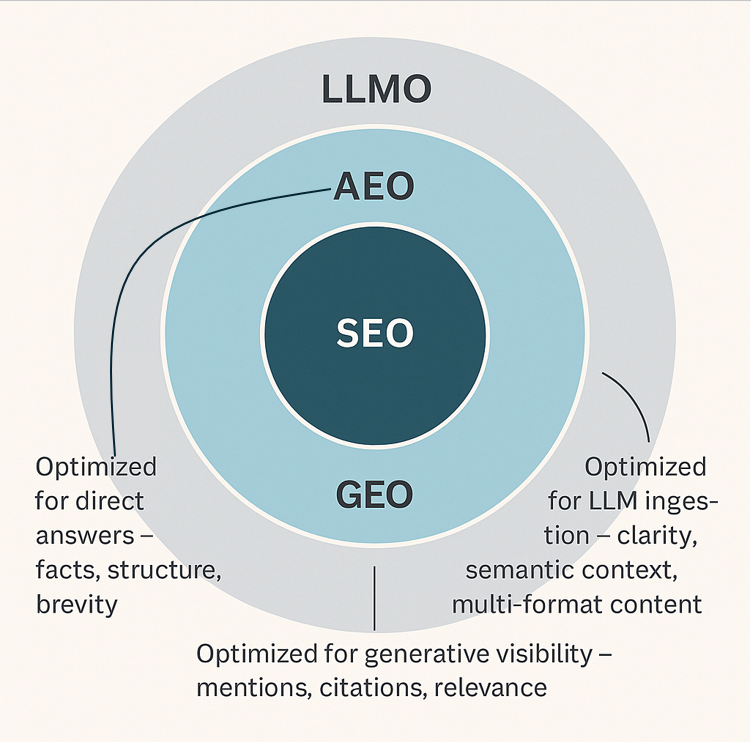
Overall we can say SEO is the art and science of improving your website’s self-earned visibility in traditional search engine result pages—think Google, Bing, and others. It involves keyword strategy that are appealing to your target audience and generate enough volume of clicks, backlinks from third parties to your site, technical health to ensure your content is searchable, and user experience optimization to ensure Google considers you as a legit site. Whereas GEO (Generative Engine Optimization) refers to the strategy of optimizing digital content specifically for generative AI engines and platforms like ChatGPT, Google Gemini, and Microsoft Copilot. Unlike traditional SEO, which focuses on getting clicks by ranking on a SERP, the goal of GEO is to have your content be the source that a generative AI selects and cites directly in its answer to a user’s query. This is especially important in a world where AI-powered searches may provide a synthesized answer directly, without the user ever clicking through to a website.

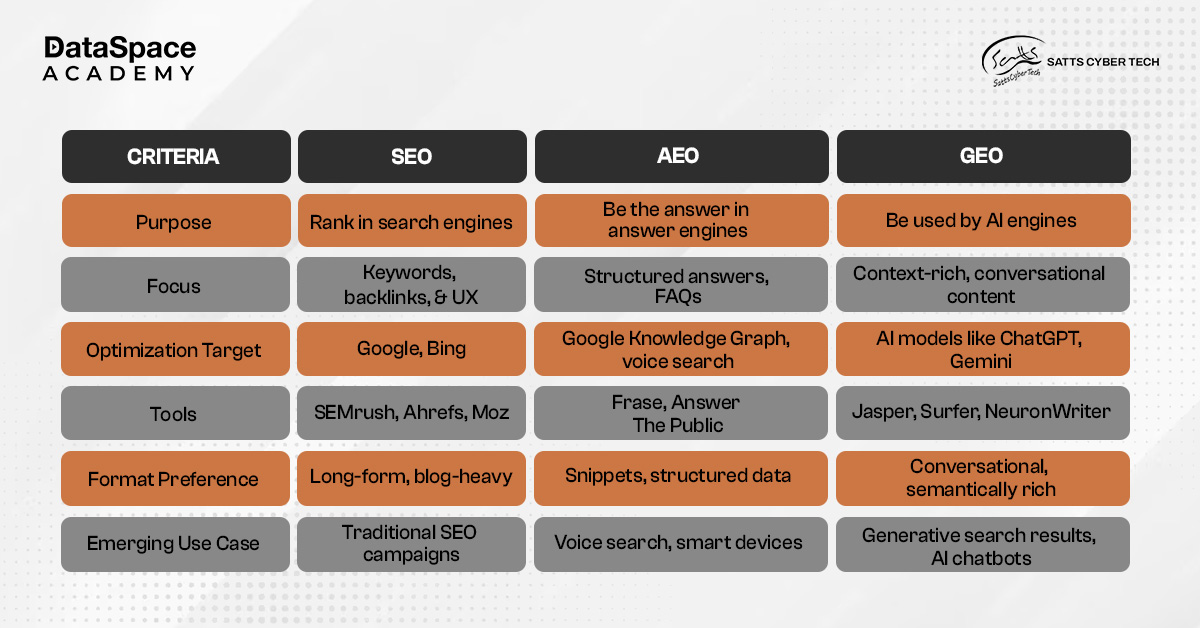
This summary from DataSpace academy can be a good take away:
So, does it mean that GEO/LLMO/AEO will or has already killed SEO?

Not at all, these three new kids on the block build on SEO fundamentals: While they have different goals, these new optimization strategies don’t really replace SEO. It is true that it will diminish its power but since they are built on core SEO principles we can see them like an evolution of SEO. For example, domain authority will still be important for both SEO and GEO for the search engines or AIs to know which publisher is more trustworthy and technical SEO (like site performance and structured data) remains crucial because it helps AI models crawl and understand your content, however backlinks and keywords analysis may lose relevance. Overall the difference is the focus: SEO is for humans and bots to find your site, while GEO/AEO/LLMO is for AI to summarize your site for your prospects and customers.

This Still Looks Really Bad. I spent a lot of time and effort on my SEO channel, is Everything Ahead Dark?

Not at 100%. SEO + GEO together can still unlock a massive opportunity, what you need to understand is that traditional SEO only is dead. Businesses that adapt early will enjoy higher trust and authority. AI is becoming the front door to the internet; being cited there gives you influence far beyond what clicks alone ever did. The upside? Faster customer acquisition, higher conversion, and a seat at the table of how AI engines “think.” People will still visit sites but prospects will likely take the first one or two steps of the search, leaving Website visits for users that are more advanced on the sales customer journey, in other words, SEO traffic volumes may decrease, but overall conversion rates could increase… this is based on my own experience and site traffic…. however ultimately time will say…. 🙂

Some example of those positive synergies can already be found: Standout Brand – Airbnb – Its “Neighborhood Guides” consistently rank high in SERPs and are frequently referenced in AI travel summaries, positioning Airbnb as a good example of GEO+SEO synergies

StrategySEOGEO/AEO
GoalRank webpages in SERPsEarn citations in AI answers
TacticsKeywords, backlinks, UX, schemaFAQs, structured data, lists, authoritative tone
OutcomeOrganic traffic growthAI-driven visibility & conversions
ValueClicksTrust, brand recall, sales

Measuring AI Impact & ROI

We are all familiar with the key indicators of SEO and other Digital Marketing channels (if not, check this article with the key metrics of the industry) and we should be adding a few more to our list:

  • AI Citation Rate – how often AI mentions your content / site.
  • AI Referral Volume – visits from AI sources (ChatGPT, Gemini). This video explains it very, very well https://www.youtube.com/watch?v=CywCLvPmGDc
  • AI Conversion Rate Comparison – for a given business goal (lead, sale, renewal), check the % of users that came from AI traffic vs. SERP traffic or other channels and completed that goal.
  • AI Engagement Metrics – differentiate session length and depth from AI users compared to SERP.
  • AI Revenue Attribution – tracking AI-driven leads/sales.

If you are hands on, there is no time to lose! Here’s your first action plan to blend SEO with AI-era marketing:

  1. Strengthen SEO foundations: technical SEO, keyword strategy, mobile speed, UX. Without this, GEO won’t stick.
  2. Restructure for GEO/AEO: Review your FAQs, schema markup, conversational formatting, bullet lists. Write content in “answer mode. Ensure you capture everything your users ask and do not worry about text length, AIs can process as much text as you want! Ensure you have FAQs for your brand, each of your products and services”
  3. Blend classic digital marketing: support with paid search, email nurture, and social proof. Use these channels to amplify AI-optimized assets.
  4. Feed the LLMs: Publish high-authority, evergreen content that AI wants to cite. Include stats, definitions, and unique perspectives. AIs will act as Search Engines, they will keep scanning for new content all the time, everywhere.
  5. Measure smartly: Go beyond “rankings.” Track citations, referrals, conversions, and long-tail visibility in AI.
  6. Iterate continuously: AI models evolve quickly. Refresh and re-optimize content quarterly, not yearly.
  7. Think omnichannel: Pair SEO/GEO with influencer mentions, podcasts, and social signals—elements AI increasingly ingests to assess authority.

To conclude, do not think of SEO vs GEO as a choice. Think of them as a blend of traditional digital marketing and AI-era optimization. Those who adapt fastest will own visibility in both blue links and AI answers!

References

Moz: Generative Engine Optimization, LLMO and AEO explained — [Moz blog on generative engine optimization][turn0search9].

Ahrefs: “GEO is just SEO” — highlighting synergy and overlap — [Ahrefs blog][https://ahrefs.com/blog/geo-is-just-seo].

SEMrush: Deep dive into why GEO matters now — [Semrush blog][https://www.semrush.com/blog/generative-engine-optimization/].

Single Grain: GEO case study with 32% of SQLs and 800% traffic growth — [Single Grain GEO case studies][turn0search1].

a16z: GEO as system of record for LLM presence — [a16z article][turn0search3].

Writesonic: Detailed GEO guide — [Writesonic guide][turn0search5].

GloryWebs: SEO success stories including Airbnb — [GloryWebs SEO case studies][turn0search6].

Medium: Decoding AEO, GEO, and LLMO: The New Playbook for AI-Era Visibility

The Digital Sales Funnel

Digital marketers often refer to the marketing funnel by different names, such as the purchasing funnel or sales funnel. Regardless of the terminology used, this tool is essential in any marketing plan as it helps define user journeys and connect marketing and sales activities.  (Wikipedia definition for reference),

Defining the Marketing Funnel

According to YourBusiness, a marketing funnel is a system that tracks the stages consumers travel through to reach a buying or target decision. In other words, it maps out the user journey along your marketing and sales process. Understanding the marketing funnel and its different stages is crucial for effectively monitoring and optimizing your campaigns.

Below we are consolidating some of the most common funnels, drafting a list of general steps for each of them and adding some comments about the Digital Transformation challenges Digital Marketers and Analytics teams may face on ROI tracking and monitoring activities

Different Industries, Different Funnels

Funnels vary across industries based on the purchase decision process and the available user journeys. Each industry and market has its specific funnel, which affects the costs and conversion rates at each stage. It is important for digital marketers to understand these funnels to connect traffic to specific actions, monitor performance, and define optimization processes.

On this list we are presenting a first list of the most common journeys we will face. Each industry and market have different number of steps which will affect the costs (CPI, CPC, CPA) and to the conversion rates along the journey.

Let’s Explore Some Digital Marketing Funnels Across Different Industries

  1. Leads generation and Online to offline funnels

Education, construction, automobile, health and care, financial services and other high-value service industries often utilize online-offline funnels that generate leads, specially in B2B businesses. The key step in these funnels is how to convert engagements into leads at a profitable price. Digital marketing goals usually revolve around driving traffic to specific landing pages through content, competitions, discounts or white papers in order to pipe those  users into registrations or leads. To optimize these funnels, consider leveraging lead tracking and management systems, to be able to map new sales to the sales channel that generated it. If you are able to track the piece of content that generated the engagement, you will be able to generate insights that can be used by your content development team to optimise CTA and  improve your  branding campaigns support to sales. You can learn more about attribution on this other article – Attribution, a key concept (…).

Education, construction, automobile, health & care and other high value services industries that require consulting tend to use this funnel, where “leads generation” is the key step.  You may find this funnel labelled as D2D (direct to distribution).

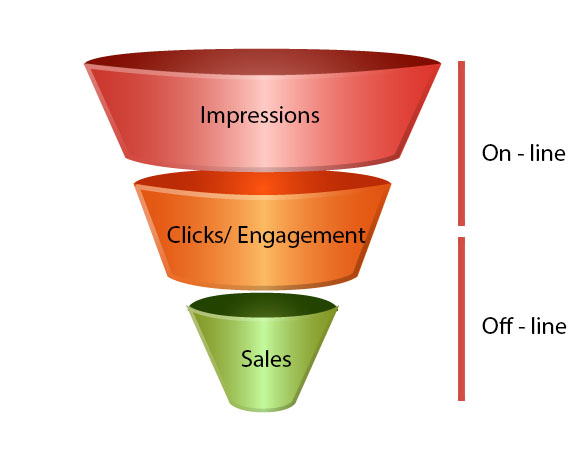
    1. The digital marketing goals is usually to generate registrations (leads) by driving traffic (impressions + clicks) to specific landing pages
    2. The leads database is transferred to distribution teams (sales departments, partners) generally via CRM/ERP. The distribution teams may receive these leads in specific Aps or back-end systems.
    3. Teams in charge of manage leads (Telesales dept, Agents or re-sellers) will try to arrange consultation meetings (can be online but offline are more popular). CRM-ERP should be used to track the number of calls, lead status, etc.
    4. Ideally the systems in charge of handling the leads to the Sales Team should send back the management info to the CRM/ERP for monitoring processes.
    5. Afterwards, users can be re-approached with re-targeting campaigns through different channels: SMS or E-Mail marketing, etc..

Example: The education industry in Thailand and Vietnam has an average CPL – cost per lead (user registration) of 8 – 6 USD and an average CR of 3% to 10% depending of the channels.

funnel 1
Common in companies that need personal consultation: Real State, Auto, Education, etc…\

Digital Transformation effort to track & optimize: These funnels are perhaps the hardest one to monitor and track ROI (Return on investment) since require the consolidation of off-line & online data sources. Moreover, we will require to ‘capture’ and ‘carry out’ IDs from our external touchpoints when the lead or interest confirmation is submitted in our touchpoint.

Those business that have to differentiate among their customers VS non-customers for compliance purposes – financial industry players (Banks, Insurances, …) will need to add another layer of complexity.

2. Brand support focused funnels: Online and one way communication funnels. 

A large amount of companies focus their Marketing activities on promoting their brands only, since final sales are outsourced to other retailers. This is a very typical example of Fast Movement Consumer Goods (FMCG) companies (like Unilever, Coca-Cola, Nestlé, Heineken), Apparel (Nike,….), Film Industry (Paramount, Universal), etc,  Their key characteristic is that they do not have their own point of sales and rely on third party retailers (shops, cinemas, …) their campaigns often focus on branding only:  generating impressions and engagement without unit sales targets.  These funnels rely heavily on captivating content, influencers, targeted communication plans and trends adoptions, to generate demand and push customers to locate the closest retailer they can find. Tracking these funnels is relatively simpler since sales tracking is rarely required. If it is, the mother company will have to integrate with their retailers, which is becoming more and more common. In overall for this funnel:

    • Marketing plans are based mostly on communication plans to introduce products, trends or promotions.
    • On-line communication materials that use influencers, connecting and inspiring with target audiences. Tone, channels and messages must be consistent among time and usually take longer time to reflect on sales.
      Funnel 2

        FMCG Funnel – Companies like Unilever, Nestle or L’Oreal tend to use this funnel on their branding campaigns

3. Direct Sales Oriented Funnels

Industries such as airlines, B2C retailers, NGOs/crowdfunding, retailers, professional services or entertainment companies  – tourists packs, Streaming services, adults content and others – are capable to implement a 100% online purchasing focused on driving direct sales.

    •  Digital marketing plans for these industries often aim to drive traffic to purchase product pages, distributor contact pages, or custom research landing pages. (Ex: Lazada Thailand), distributors contact page  (EX: Alibaba Thailand) or to custom researches focus on drive traffic to landing pages where where people move from seeing to buying.
    • Leads generation may also be included in these funnels. Tracking these funnels is generally simpler since the entire process occurs online.
    • Considerations such as cancellations, wrong orders, and stock depletion need to be accounted for to ensure accurate tracking and optimization.
    • Example: USD crowdfunding  pages have an average CR of 1.5% (Wedidit source)
    • amazonAmazon, Lazada and big E-commer portals hold a 100% online funnel

      Digital Transformation effort to track & optimize: These processes are usually simpler to track (from Digital Transformation perspective) since the whole funnel occurs online.

      Nevertheless tracking and optimization processes will have to consider events like ‘cancellation’, ‘wrong orders’ or ‘stock depletion’ or other reasons that may force your business to cancel the order. Once that happens, we’ll be forced to review some of the “sales” counted that need to be reviewed.

      Tracking processes of current customers should be easier than those for non-customers, since full online provides may store most of the info needed for future transactions on their ‘Customer profiles’ after they sign-up/

4. Mobile Marketing Funnels: Mobile marketing plans for apps or music services primarily focus on app installs and maintaining active users. These funnels require driving traffic to specific landing pages or app store pages for installations. Keeping users engaged and active is crucial, and inbound marketing plays a significant role in achieving this. Mobile funnels tend to be larger and more challenging to maintain.

    • Digital activities focused on drive traffic to specific landing pages or straight ahead to App’s stores pages (iTunes or Google Play install page)
    • This funnel is longer than usually as you have an extra step: Keep your users active. For this channel is extremely important to provide constant value through Inbound Marketing to keep your community active

      mobile funnel
      Mobile Funnels are the largest and hardest to maintain funnels
  • Monitoring the average cost per install closely is essential, as performance can vary based on location and segments. The e-commerce industry in Thailand and Vietnam is around 1 USD and the CR is around 10%, whereas in developing countries, that prices rises to 40 to 50% more Memeapp cho Phien source

A good example of good mobile funnels is Trip Advisor.

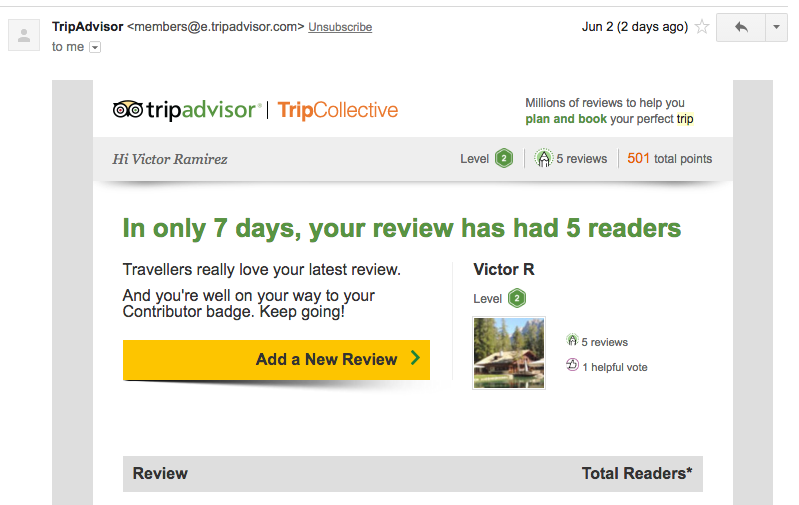
Trip advisor follow their users based on their GPS location and recent researches. When they see that users have moved to other city and have looked for restaurants on the app, they re-approach requesting for reviews. Moreover, they deliver custom reports of how many people viewed their reviews

Screen Shot 2016-06-04 at 3.29.46 PM
Trip Advisor actively encourage users to icrease the weekly / monthly open rates with dedicated E-Mail Marketing Campaigns

Digital Transformation effort to track & optimize: These funnels are usually complex since:

Mobile App implementations are always more difficult that Web implementations and will require tailor solutions for Android and iOS, whereas in Web a single solution is easier to reuse.

The app installation may not be the final objective of the investment and other journeys completion may be required.

To sum up

… understanding marketing funnels is crucial for marketers across any industry. By leveraging industry-specific enhancements, such as advanced lead management systems, personalized remarketing, data integration, and mobile optimization strategies, marketers can optimize each level of the user journey and drive better results. Stay informed about emerging trends, conduct thorough research, and adapt your strategies to ever-evolving customer behaviors for continued success.”

User creation and activation may require extra activities like ‘user registration’ or ‘OTP confirmation’ that will increase the complexity of the technical set up.

Overall, the marketing funnel is one of these concepts that every marketer should understand at high level, not only within their industry but also on other third industries.

This knowledge can bring marketers to better partnerships, variants and combinations to optimize each level of the user journey

Facebook & Google In-House Ads Accounts: How to improve media buying Transparency

During the last weeks I had to explain this issue several times, so I realized I should write a new Blog post to save time in future meetings 😀

With this article I pretend to introduce the big value that in-house accounts can provide to every small and medium company. Overall it will help to:

  • Increase transparency
  • Maximize investment
  • Boost performance.

I will based my article on the Facebook and Google accounts as these two ads platforms allow you to invest in media on Facebook, Instagram, Google Search, YouTube, G-Mail, Maps and GDN however we can extend this to any other traffic / media buying platform that offers a client panel.

Ok…. So, what is the problem? Why is there an overpricing on Facebook and Google media purchases? How is the current situation?

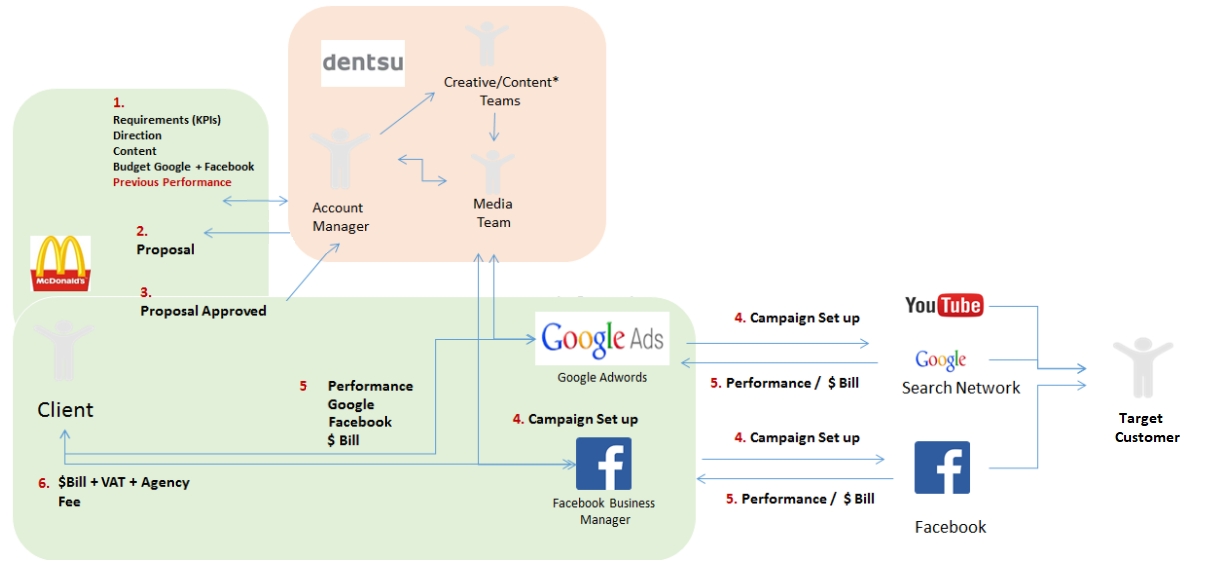
The chart below could be a good intro of the scenario. Let me go step by step:

Blog Visuals

Agency Accounts management

Let’s say that Mc. Donald’s has a brand new product that wants to boost and asks their Digital Agency (lets say…. Ogilvy, Leo Burnett, Dentsu or other digital group) to run a campaign in Facebook, YouTube and Facebook. For the example I will chose Dentsu due to the recent scandal commented to by the Financial Times they had in Japan for similar practices.

Long story short, the key problems starts when the Vendor proposal doesn’t provide:

  • Final performance of Clicks (CPC) / Engagements (Cos per engagement) gaps* based on Facebook/Google Ads estimations or variable costs. Instead of that, Vendors tend to propose fix Unit Cost (cost per click, cost per engagement, etc…) that most of the times are three to four times higher than they are actually paying to Facebook on average.
  • Access to the client to their Facebook / Google Ads accounts
  • Support to their clients to create their own accounts

At this point, some of you may think:

  1. Why should they provide a gap? – Most of the big digital publishers (Facebook, Google, Yahoo!…. do not have fix pricing lists but complex bidding systems (click her for further info)
  2. Why they bill 3-4 times the price they pay to Google/Facebook?

I may be defending the devil but it is true that there are several reasons to behave in that way like:

  • As a back-up in case they fail in their estimation.
  • As a back-up to spend less time in optimization/set ups.
  • Media budgets are usually 20% – 50% of the total costs. Big agencies charge big fees in creativity and content direction that cover media overspending.
  • To earn more money – Good agencies. Good optimization teams master their jobs in order to boost the gap from the ‘Unit Cost’ accepted by the client and the price they finally pay to the publishers
  • To ease quotations and boost long term plans.

Given this point, the agency (usually) finishes the quotation with a unit cost a way higher than the market price.

  • The agency delivers a proposal:
  • The Client approves: Let’s go!
  • The Agency uses their own accounts to work with the publishers:
  • Facebook Business Manager Account to pay Facebook for Facebook ads, Instagram Ads, etc…
  • Google Adwords Account to pay Google for ‘Google Search Network, GDN, YouTube Ads, etc…

Facebook and Google deliver ‘performance report’ and ‘bills’ (this is the key) to the Agency, not the client. Afterwards the Agency sends back the invoice but they (almost never) include the Facebook or Google Invoice…. In other words… The client has no clue of how much money the agency paid for the services!!!!

This is a big problem because Mc. Donald’s actually cannot request Facebook how much money the agency spent on the campaign:

  • Facebook client is Dentsu, not Mc. Donalds’s.
  • Facebook has no liability of giving any explanation to Mc. Donald’s.
  • Facebook is not allowed to display any data of Dentsu account without their approval.

Damnnn, how can Mc. Donald’s solve this issue:

Ask Dentsu to grant you access to their account: agencies may reject this option claiming that these accounts have data of other clients they do not want to share

In-house accounts.

By having in-house accounts Clients get the full control of how much money is spent in Facebook. Given this point, Clients have two options to run campaigns:

  1. Let the Agency use their account: By granting advertising permissions to the agencies, Clients can monitor the performance and the budget spent by the vendors. On top of that, they can access to the detailed performance information and develop digital know-how of the industry for future plans
  2. 100% In-house campaigns: Clients can run campaigns by themselves without agency intermediaries, which usually saves the ‘agency fees’ plus the VAT costs. Recommended only if the ‘head of digital’ has a strong background and extended experience

Attribution, a concept that may save you when you need it the most!

Digital agencies, heads of digital marketing, and performance teams often grapple with a challenging question: ‘Why do we continue investing in Channel A or Channel B if they are not profitable?’ This article aims to offer clarity and guidance on this matter by delving into the concept of attribution and its crucial role in measuring the effectiveness of various marketing channels.

The Importance of Attribution: Attribution is the scientific method of assigning values to individual digital touchpoints throughout the customer journey, starting from the initial interaction with your brand or product and extending to the final purchase along the marketing funnel. It enables you to accurately assess the impact of each channel and activity along your marketing or sales funnel. Proper attribution not only optimizes marketing  funnel and campaigns but also provides valuable insights into the actual return on investment (ROI) of each channel, making it a crucial factor to consider during budget allocation reviews. The article ‘Rethinking today’s attribution problem in digital marketing ‘ would serve as an excellent supplementary resource.

Exploring Attribution Models: There are various attribution models that exist, each designed to distribute conversion credit in different ways. By understanding these models, you can gain a deeper insight into the effectiveness of your marketing efforts and make well-informed decisions. Let’s delve into some of the most popular attribution models.

attribution models

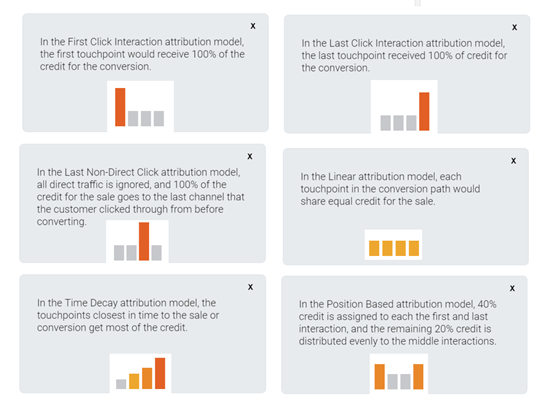
  1. First Click: This model attributes credit to the channels that initiate the customer journey, including first-click channels such as Facebook posts, GDN banners, organic search visits, and email marketing activities. Comparing the results of the First Click model with the Last Click model can be powerful as it allows you to optimize your content and visuals based on their respective contributions
  2. Last Click: The Last Click model is the most common attribution model. However, it carries certain risks as it tends to overlook the significance of the first interaction. It’s important to remember that most users interact with your brand multiple times before converting, making the first interactions crucial. Relying solely on the Last Click model may result in disregarding the top-of-funnel channels, potentially hindering the effectiveness of your remarketing efforts.
  3. Last Non-Direct Click: This model addresses two requisites. Firstly, it ignores direct traffic and considers only organic, referral, paid, social, and other sources. By filtering out direct traffic, which typically comes from existing customers, employees, or common users acquired through a different channel, you can focus on the last marketing activity before conversion. Secondly, it ignores the second-to-last click, giving more credit to the referring channel by disregarding the click immediately preceding the final conversion.
  4. Linear Model: In the Linear model, equal credit is assigned to every channel involved in the conversion. This approach ensures that all touchpoints along the customer journey receive acknowledgment for their contributions.

By relying solely on the last-click model, you may unintentionally overlook the early, top-of-funnel activities that play a crucial role in driving customer engagement and awareness. Focusing only on bottom-of-funnel elements like branded search and remarketing, which tend to drive the final conversion, disregards the value and impact of the channels that contribute to the initial stages of the customer journey. Neglecting the significance of top-of-funnel channels can lead to diminishing returns on your remarketing efforts over time.

If you have more questions, feel free to visit this  Google Support link that elaborates further these points.

 Why is it important to consider attribution models beyond the ‘First’ and ‘Last’ click interactions?

While models like time-decay and metric-driven attribution offer more sophisticated approaches, they still have limitations. These models may assign arbitrary values and fail to account for gaps when customers switch between channels, particularly in cases where the transition occurs from online to offline interactions.

To gain a comprehensive understanding of your marketing efforts, it is essential to explore various attribution models and choose one that aligns with your specific business goals and customer behavior patterns. This holistic approach allows you to capture the value of each touchpoint along the customer journey, optimize your marketing strategies, and drive long-term success.

Remember, attribution models should be regularly reviewed, refined, and adapted to ensure they accurately reflect your evolving marketing landscape and customer preferences.

Conclusion: By understanding and leveraging attribution models, digital marketers can gain valuable insights into the effectiveness of different marketing channels throughout the customer journey. This understanding helps optimize campaigns, allocate budgets more effectively, and unlock the true potential of your marketing efforts.

Remember, attribution is an ongoing process that requires continuous refinement and adaptation to your specific business goals and cu

Why is it important to consider attribution models beyond the ‘First’ and ‘Last’ click interactions?

While models like time-decay and metric-driven attribution offer more sophisticated approaches, they still have limitations. These models may assign arbitrary values and fail to account for gaps when customers switch between channels, particularly in cases where the transition occurs from online to offline interactions.

To gain a comprehensive understanding of your marketing efforts, it is essential to explore various attribution models and choose one that aligns with your specific business goals and customer behavior patterns. This holistic approach allows you to capture the value of each touchpoint along the customer journey, optimize your marketing strategies, and drive long-term success.

Remember, attribution models should be regularly reviewed, refined, and adapted to ensure they accurately reflect your evolving marketing landscape and customer preferences.

Conclusion: By understanding and leveraging attribution models, digital marketers can gain valuable insights into the effectiveness of different marketing channels throughout the customer journey. This understanding helps optimize campaigns, allocate budgets more effectively, and unlock the true potential of your marketing efforts.

Remember, attribution is an ongoing process that requires continuous refinement and adaptation to your specific business goals and customer behaviors. By embracing attribution, you can make more informed decisions, maximize ROI, and drive long-term success.”

By embracing attribution, you can make more informed decisions, maximize ROI, and

Related articles you may enjoy:

  • What’s the best attribution model For PPC? –
  • Attribution modeling overview – Link
  • Guide to Google Analytics Attribution Models – Link
  • Understanding View-Through Attribution – Link

https://platform.linkedin.com/badges/js/profile.js

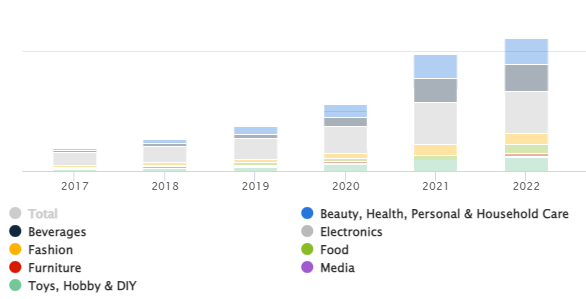
Top ASEAN eCommerce sites

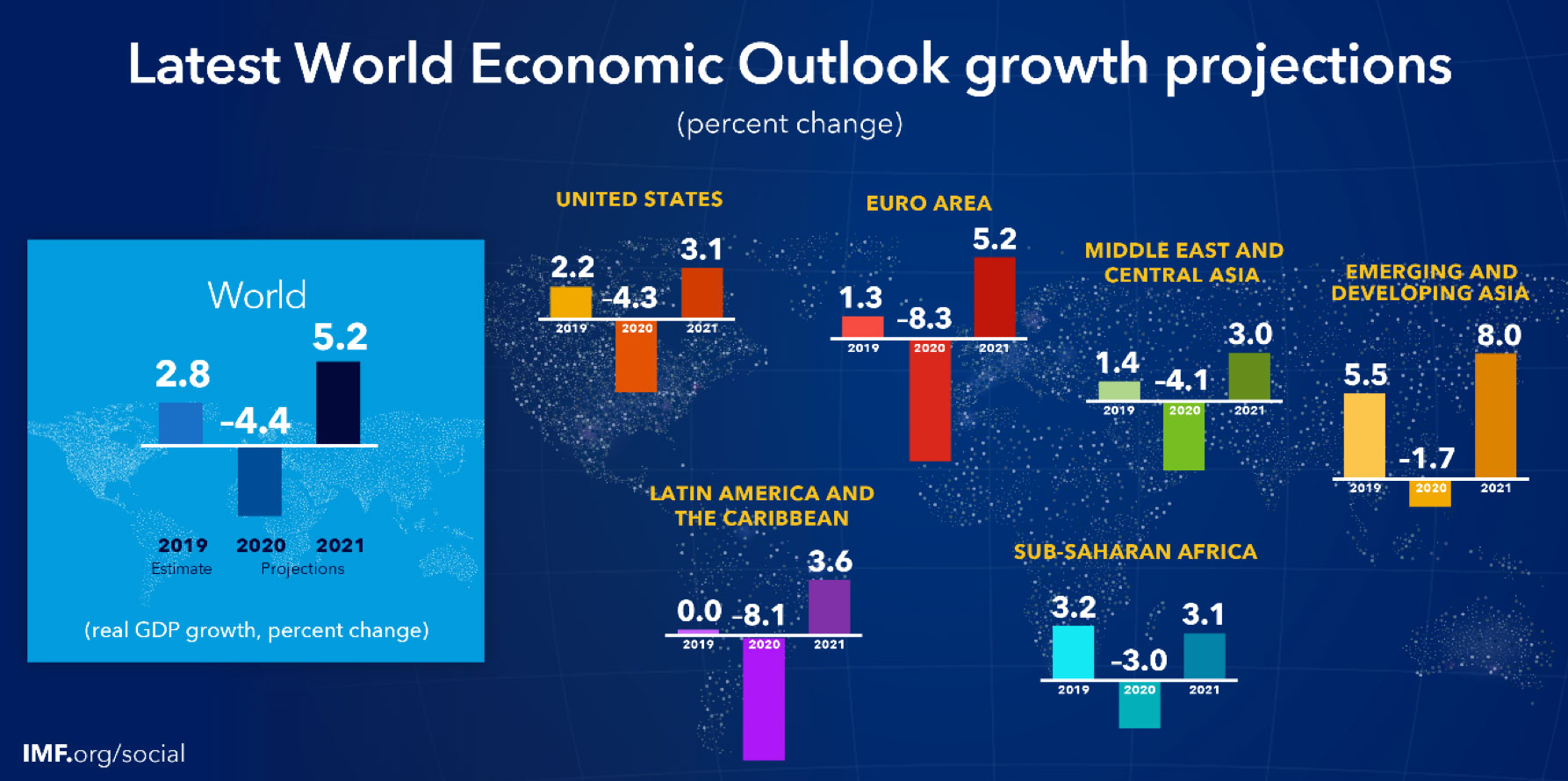
I often receive questions about the most common and popular eCommerce sites in Southeast Asia. Each day, this question becomes more complex as it is one of the most digitally dynamic regions in Asia and the world. Nevertheless, I will attempt to provide a summary of some of the most relevant platforms in case you are interested in partnering with them, selling your products, or simply want to explore popular articles in a region that is experiencing rapid economic eCommerce grow expectations in the world according to the IMF.

Based on B2C (business-to-consumer) and C2C (consumer-to-consumer) platforms, excluding B2B (such as Shopify), the following are some of the most popular eCommerce sites in the largest markets of Southeast Asia: Indonesia, Thailand, Philippines, and Vietnam. Please note that these platforms are present in multiple markets, providing a good overview.

Indonesia

With a population over 280 million, ranking fourth globally, Indonesia’s eCommerce market is projected to reach a revenue of US$62.59 billion in 2022 according to statista. Despite this, it is often as an overlooked as a market. Some of the most popular eCommerce sites in Indonesia are.

Indonesia

With a 278.3 million population, the fourth largest globally, Indonesia eCommerce market revenue is expected to reach US$62.59bn in and is often seeing

Some of the most popular eCommerce sites:

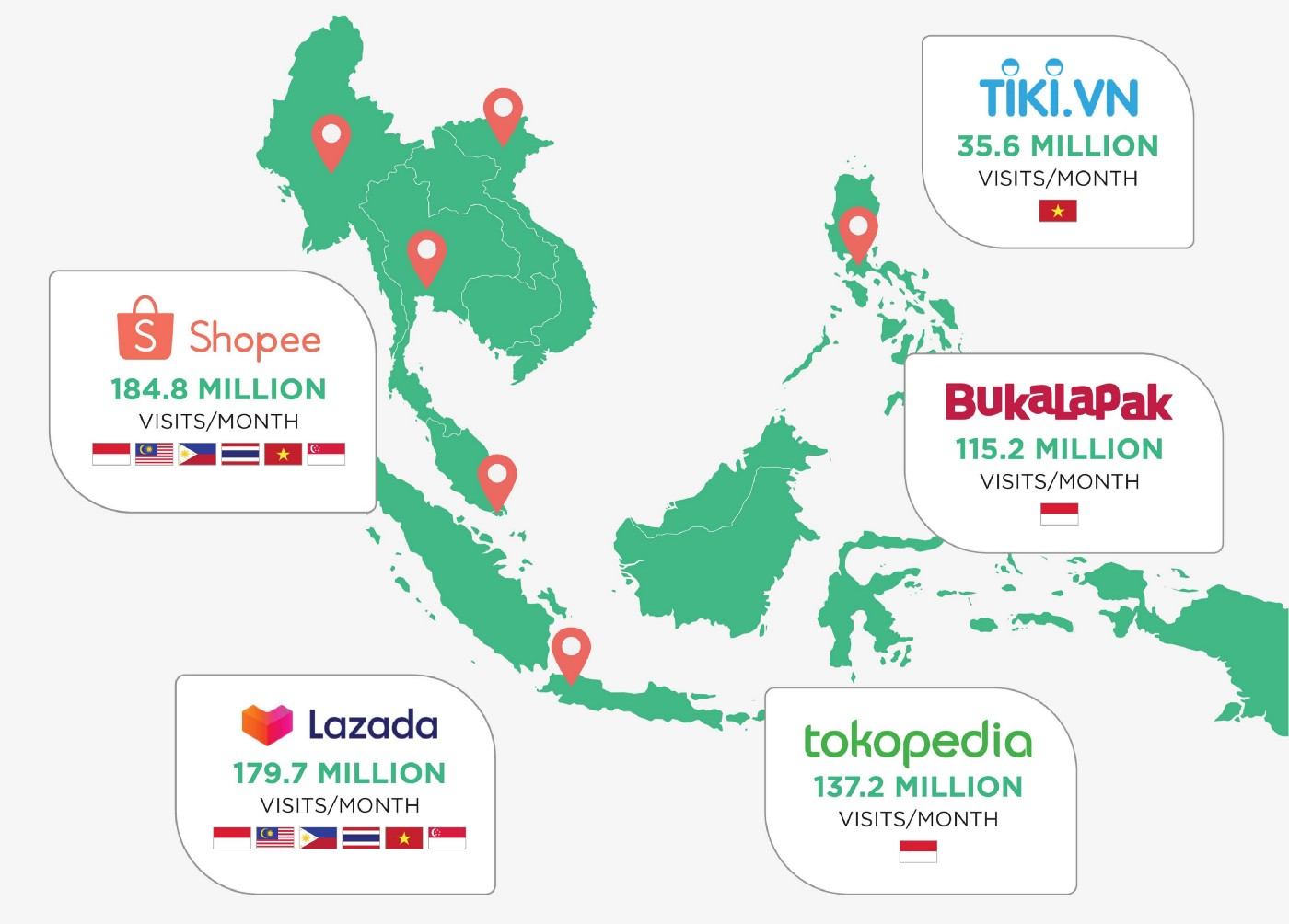
  • Tokopedia – www.tokopedia.com – perhaps the largest and free C2C business platform for merchants and buyerse in Indonesia. To sell on Tokopedia, you need to set up a local company (almost all of them need anyway), which is not the easiest task on hand, some steps on this link. Don’t forget that Tokopedia is still in an early stage. As mentioned, it brings many similarities to what the popular Chinese Taobao was a few years back. Perhaps the easier place to find super cheap products and local providers for Mobile, Electronics and Fashion, which account for almost half of their transactions.
  • JD https://jd.id/ The Chinese giant has also experienced a huge growth in the last years. In some statistics is placed over Tokopedia. Probably more diversified than the other peers, offers offers not only a lot of electronnics but also flights, hotels vacation packages and data services
  • Shopee – https://shopee.co.id/ – in some research appear over Tokopedia as the most popular site but still lags behind Tokopedia in visits. Present across the whole region, is a listed company in Nasdaq – NYSE: SE – they have their own product stock but has traditionally positioned themselves as a ‘merchants’ market place where small and medium companies and individuals can sell their own products – B2C shopping platform – since they posses a wide range of consumer goods from Southeast Asia and South America.

    Shopee, like any e-commerce platform, intemediates between sellers and buyers of goods. The company’s revenue comes from charging its seller’s transaction-based fees, advertising services, and value-added services.
  • Bukalapak https://www.bukalapak.com

    Probably with more traffic but lower revenues than Shopee, visit this link to learn how to sell in Bukalapak. More similar to Tokopedia, Electronics and low cost fashion are also the most popular categories.

Bukalapak

Other sites: Orami, Ralali, Kaskus and Blibli are also popular options.

Vietnam

Market size estimated in $151bn in 2022 according to statista – it should be much bigger since Facebook and the local Zalo WeChat are also heavily utilized – and the fastest growing market of the region.

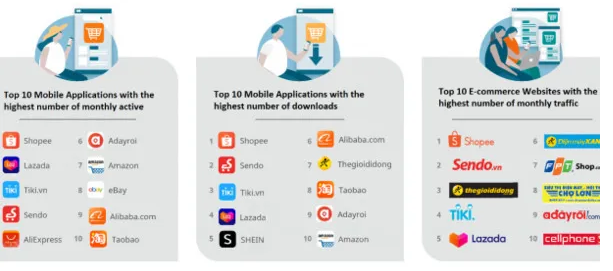
The graphic below is from 2020 but it gives a good overview of apps and platform in terms of traffic.

Shopee https://shopee.com/ – and its competitor Lazada are the traditional leaders, with very similar offers to their neighbor countries, the main categories stand as fashion, toys, Hobby & DIY plus the always present electronic components.

Tiki – perhaps the largest 100% local Vietnamese platform, Tiki (“Tìm kiếm & Tiết kiệm”, which stands for “Search & Save”) claims to be the Vietnam’s fastest and most trusted B2C e-commerce platform.

Tiki.vn is expected to become a key competitor for Shopee and Lazada since they recently published how it managed to raise $258 million and is expecting to go IPO in the US shortly (Bloomberg) , supported by AIA, leading insurance provider in Asia that also closed an exclusive partnership to distribute insurance on their platform.

Similarly to Amazon, Tiki become popular by leading literature, children, economics books and manga comics before they expanded into other services and included blogs, articles, polls, forums, wiki pages, file galleries and trackers. This guide can help to learn how to sell in this platform

Thegioididong https://www.thegioididong.com/ – stands for ‘the mobile phone world’ is probably the leading eCommerce and offline(counts with a extended network of physical shops) across the market, however they are mainly resellers and do not offer a direct marketplace as Shopee or Tiki.

Cho Tot. http://www.Chotot.com which stands for ‘the good market’, was one of the first listing companies and was considered the Vietnamese Craiglist. Founded in 2012 as an online classified marketplace for connecting buyers with sellers and was purchased by ‘Carousel’ , Singaporean leading classified with presence in in Australia, Hong Kong, Malaysia, Indonesia, and Taiwan, raised $80 million USD funding recently.

Other local platforms like Adayroi (I found it) and Sendo are also important platforms to keep in mind.

Philippines

With a total market over $20billion, the Philippines is another fast growing market, perhaps more stable than the other Asean markets, with three key players that have been leading the industry for several years Lazada, Shopee, and ZALORA.

ZALORA – https://www.zalora.com.ph/ Providing services in Indonesia, Malaysia, Taiwan, Hong-Kong, Thailand, and Vietnam, ZALORA used to dominate across the region however it has lost popularity in almost every market with the exception of Philippines they are mainly focused on shopping for fashion, carrying an ever-expanding line-up of top local and international brands tailored for consumers. To learn how to sell, follow this link

Metrodeal https://www.metrodeal.com/ is perhaps the unique large local platform. Headquarter in Metro Manilla, Metrodeal is specialized in coupons and deals gathering promotions for restaurants, leisure, shopping, travel and recently moved into process payments directly placing them on this e-commerce ca

Globe https://shop.globe.com.ph/ is perhaps the second largest local player, however most of its market share probably come because of its position as one of the country’s top conglomerates which is trying to break into the country’s burgeoning eCommerce market. Online shopping at Globe is mostly focused on electronic devices, gadgets, apparel, post-paid network plans and other services. Steps to open your shop on the following link

Other platforms are the omnipresent Shopee, Lazada and eBay, which still keeps a decent market share compared to other markets in which has almost disappeared.

Thailand

As usual, different sources offer different estimates of the total value of the eCommerce value of Thailand, but most of them agree that the growth rate is not ramping up as quickly as Indonesia, Vietnam or Philippines.

Using statista as a benchmark, Thailand has a $20bn market

Revenue in the eCommerce market is projected to reach US$22.20bn in 2022, a particularity of this market is that a significant amount of these revenues are generated in China by Chinese resellers that live and sell products to mainland china

In terms of categories, the market behaves similarly to its peers in terms electronics, but with a higher volume of beauty, household and personal care products which are very popular across the whole Asia

Shopee and Lazada stand as market leaders, similarly to Philippines, however the are two local market players that worth to mention:

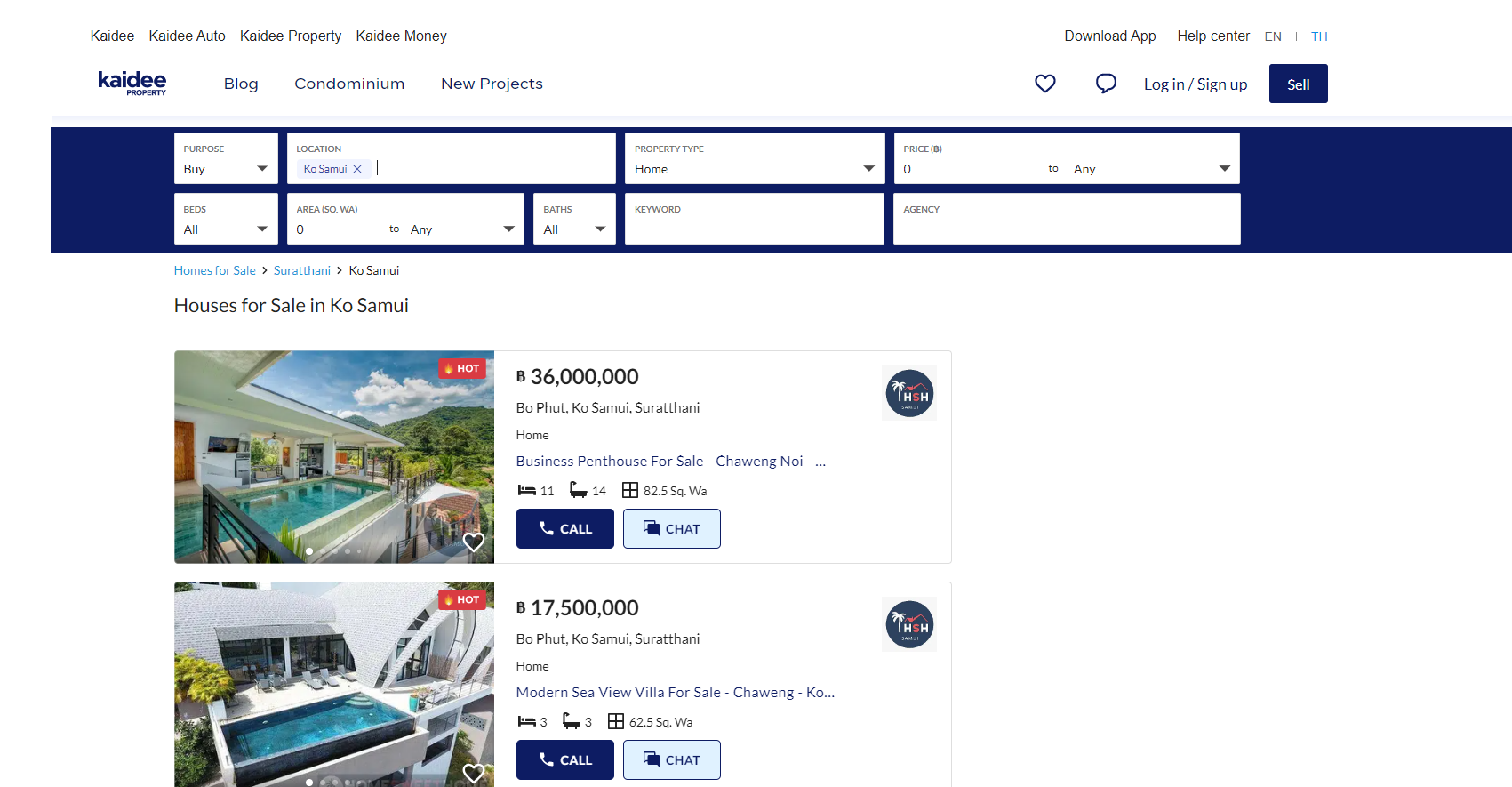
Kaidee https://www.kaidee.com/ | แพลตฟอร์มซื้อ-ขายของออนไลน์ชั้นนำของประเทศไทย

This Thai eCommerce marketplace allows you to buy almost everything, from houses (perhaps the best listing of the country) to new or second hand cars, mobile phones, fashion, toys, and much more.

Unfortunately, the website is only available in Thai and you cannot sell cross-border on the website and was officially purchased by EMPG group.

JIB – http://www.jib.co.th

Another local eCommerce player, JIB are mainly focused on electronics, toys, Hobby & DYI, this online store with nationally-focused sales.

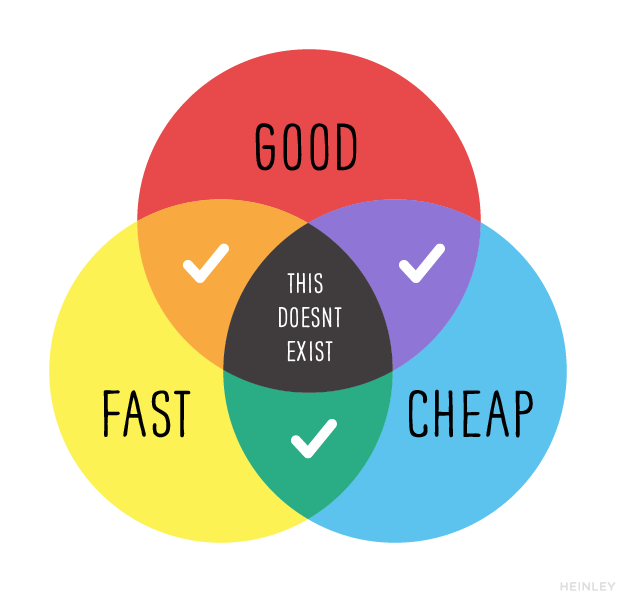
Key Marketing Principle: Fast / Good / Cheap – You can only have 2


In a small alley of Hortaleza, the Madrid suburb where I grew up, there used to be a well-known mechanic that had a pretty famous billboard that said: ‘Rapido / Barato / Bueno – Solo puede escoger dos” which basically means: ‘Fast / Cheap / Good – You can have 2, only’

In other words, the man tried to summarize that:

  • If Fast & Cheap: He could not guarantee a good result. If not him, some junior assistant would do the job or he would it quickly and may deliver a botched job
  • IF Fast & Good: Not cheap. He used to be a good mechanic compared to other mechanics of the area, and his time had value.
  • If Good & Cheap: Not fast. He did not guarantee any timeline as he managed to cut the budget by doing the job on his free time or by delegating it on his junior assistants that he tried to monitor as much as he could.

goodfastcheap1-1This is one of these sentences I like to use with clients or peers that ask me for last-minute requests and (of course) with limited budget. As you can imagine, this principle works if you want to repair cars, motorbikes and especially with Digital Marketing Plans or websites (usually cheap and fast websites end up in big disasters as most of you may already know) but surprisingly it also works with complex bidding systems like Google Ads.

Using ‘Google Search Network’ as an example, we got the same principle by replacing ‘demand’ with ‘quality’ : usually high demanded keywords come with high volume and respond to clear needs…. in other words… are high quality keywords.


Image result for bidding icon
Google Search Network uses a ‘Bidding Systems’ to distribute traffic

More to the point, Google Search Network give us three options with our ads selection:

  1. Fast & Good: Not cheap. if I want a big volume of high demand clicks in short term I will have to pay a lot for it.
  1. Cheap & Good: Not Fast. One of the good things of Google and YouTube Ads have is that you are allowed to set up low bids for clicks and views (Search Network and YouTube Ads respective). By doing that, Google and YouTube will deliver you residual volume with low competition and usually at a much lower price… however be ready to extend your campaign for months to achieve normal volumes….
  1. Fast & Cheap: Not good. If I really want a lot of cheap clicks in short term, probably I will have to go for non-popular keywords or related to low demand businesses. This is something that can change if we spend time in finding the long-tail keywords tailored to our business. The only problem is that agencies usually cannot do it (or just do not want to spend time) very well and clients are the ones that have to spend more time doing research.

Have you ever had a similar situation where this sentence describes your services? 😉

SEO FAQ’s

After some months answering questions as an active SEO expert user in Quora, I think it is a good time to drop the answers added so far

These are the questions answered, click on the title to dive to its answer. Feel free to drop any question you may have 😉

  1. How can I rank my keywords on Google first page quickly?
  2. What is a Link Wheel and should I build one?
  3. Does it help for SEO to use a new domain name extension that includes a search keyword i.e. “design.services” for a design service company?
  4. What are some good versatile keywords for blog headlines? I have found that adding the keywords ‘list’, ‘review’ and ‘how to…” are all effective.
  5. How do I calculate PPC budget given the incomes I want to generate?
  6. How can I safeguard my website from google dorking?
  7. Who are Google’s top competitors?

Hope you find this useful!! 🙂

image
List of some frequent asked questions about Search Engine Optimization

1. How can I rank my keywords on Google first page quickly? What is the best way?

As all my pals are mentioning, SEO short term strategies are not recommended and I always try to avoid them as even if you can get impressive short term results, Google will probably ban you quite fastly

There are some tricks though you can follow for a specific keyword or for a small amount of keywords, however you will need some budget if you really want short term (only) results. Some advices:

  1. Try to to attack low competency keywords. The lower competition, the easier to hike positions
  2. Set up a website with the a domain that contains that keyword. This used to be more effective than nowadays but still works
  3. Make a proper in-page set up: ensure your keyword is in the title/meta description/meta keywords list/ etc. If you want to attack some more keywords, add a page for each of them
  4. Add some of the follow:
    1. Some video with a title related to that keyword and push the views in YouTube ads.
    2. Add maps, photos and other enriched media
    3. Set some PPC campaigns. Some people will say that this does not help too much but I have experienced SEO increased after 1–2 weeks of driving traffic consistently, however you will lose this increase after stopping that
  5. Money can get everything in this world. If you are able to engage or to get good deals from important media/ influencers or sites with high Google PR, your rank should hike too…
  6. Clicks Generators. You can algo for Clicks generators solutions like HitLeap (Get Free Website Traffic) These sites will let you ‘interchange’ clicks, a big % of them may be fake though 🙂 🙂

Good luck with that!

Link to the thread and other Answers to that questions

https://www.quora.com/How-can-I-rank-my-keywords-on-google-first-page-quickly

2. What is a Link Wheel and should I build one?

I’ve been told this is a “killer” SEO tactic. Is it more involved than starting a bunch of free blogs and linking them to my site? Is it considered “black hat”?

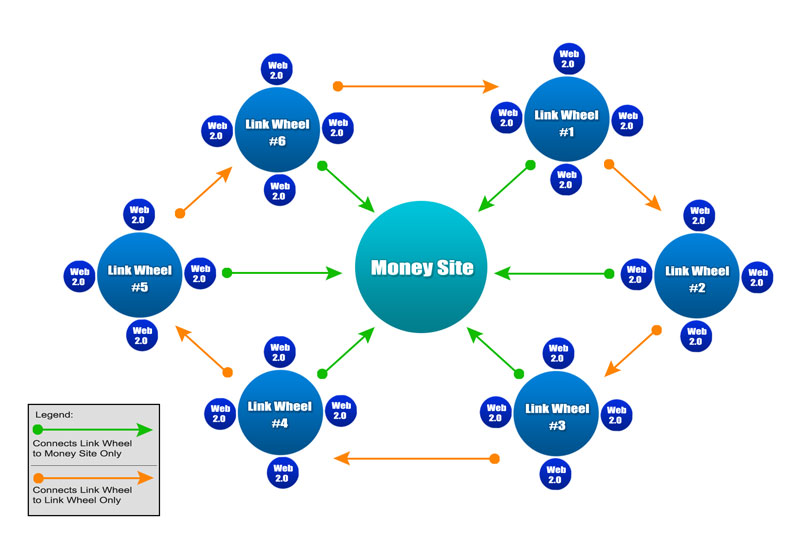
just wanted to add that some of these answers are right, and others are wrong. There are two kind of Link Wheels:

  1. Externals: the one that haters describe, Site A to Site B to Site C….
  2. Internals: Wheel of links within your pages. For example:
    • I have 20 a Hotel Chain with 20 hotels at 5 cities
    • I make a page per city and per hotel
    • I link each city page with all the hotels on that city and with other city pages
    • I link every Hotel page with the hotels of that city and with the city pages

That really is a SEO-Killer tool if you also add maps and videos per page….

Big brands like British Council are using it properly and are not penalized…. take care of where you take tips from

https://www.quora.com/What-is-a-Link-Wheel-and-should-I-build-one

link-wheel.jpg
Chain of Link Wheels: Each circle represents a Web Page, each arrow a Web Link

3. Does it help for SEO to use a new domain name extension that includes a search keyword i.e. “design.services” for a design service company?

In my opinion it does and it does not.

In a long term perspective, if this decision comes with a proper in-page set up and a content plan + backlink plans to support this page, for sure it does, specially if it is a long tail keyword and your competition is low.

However, if you already have a page with good rank, it may be better to add a new sub-page with that “keyword” as a page title, in your second level, add a nice density, find these backlinks (it is always easier to find backlinks for pages with high authority than with brand new pages)

One video with a big amount of views, maps and other enriched content will also help a way more in short term than a domain

Link to the thread and other Answers to that questions

https://www.quora.com/Does-it-help-for-SEO-to-use-a-new-domain-name-extension-that-includes-a-search-keyword-i-e-design-services-for-a-design-service-company

domain extensions
Domains are not SEO-killing factors anymore, but still helps

4. What are some good versatile keywords for blog headlines? I have found that adding the keywords ‘list’, ‘review’ and ‘how to…” are all effective.

Dear Friend,

Totally right! It is usually a good idea to set titles that match common sentences like “Lists of…”, “Top 5…”, “Must have….”, “Recommended…. “, ‘What does ‘….’ mean?’ etc..

Moreover, I would recommend you to follow these steps to maximize your in-page set up:

  • Go to the Google Keywords tool and compare the clicks demand of some of these headlines + your page key keyword
  • Try to find a combination with a high traffic and low competition. The lower competition, the lower effort and shorter time you will need to position your page on top
  • If the competition is too high, try to go for some long-tail keyword
  • Try to keep that combination on your page title, URL and some anchor

Hope you find this useful!

Link to the thread and other Answers to that questions

https://www.quora.com/How-can-I-rank-my-keywords-on-google-first-page-quickly

5. How do I calculate PPC budget given the incomes I want to generate?

Let’s say my company wants to generate 1.000.000$ a month, and let’s say the estimated conversion rate of purchases who come from AdWords is 5% (i.e. 10.000 users come from AdWords and 500 will buy). Average price for single product is 130$. How do I set an AdWords Budget that can generate that sum?

PPC.png

Dear friend,

Your question will be totally different depending on which industry you are at and how is your website.

First of all, every online business needs to identify its digital sales funnel, different industries will have different funnels, in order words, different steps between your banners or ads and your sales.

Each step will have a cost and a conversion rate, if you have a 100% online sales portal like AMAZON, your major steps will be:

  • From Web Impression to Click:
  • From Click to Sale
    • The conversion rate will be “clicks per sale”
    • The cost will be called “cost per sale” or CPA (cost per acquisition)

To my understanding your question is very blur because the CPC is not a good reference for your CPA, if your website is very slow, ugly, not friendly and lots of spam, even if your CPC is very low your CPA will be high as your conversion rate click-to-sale will be very high…

My advice is first to optimize your site, and then make a different plan to generate cheap traffic

Link to the thread and other Answers to that questions

https://www.quora.com/How-do-I-calculate-PPC-budget-given-the-incomes-I-want-to-generate

 6. How can I safeguard my website from google dorking?

My first immediate answer would be to update your Robots.txt, as this is the file that shows Google what to read and what to skip from your site.

This other Quora thread can be a good reference anyway. For further info, have a look to the Infosec Institute. These guys are web security experts (they even issue certificates) and post lots of very useful and easy to understand articles

From on their articles I extracted this info than can be useful: Defending yourself from Google hackers – InfoSec Resources

Cheers,

Robots.txt Examples:

Please follow all these disallows:

1.  User-agent: *

Disallow:

This entry will keep all robots out of all directories.

1.  User-agent: *

Disallow: /

We can specify particular directories that we don’t want. The following example, will keep all robots out of the /infosec/ directory, as well as any subdirectories.

1.  User-agent: *

Disallow: /infosec/

By not including the trailing /, we can stop the spiders from crawling files as well.

The following example will stop Google’s robots (googlebot) from crawling anything on our site, but allows all other robots access to the whole site.

1.  User-agent: googlebot

Disallow: /

The following meta tag will prevent all robots from scanning any links on the site.

1.  <META NAME=”ROBOTS” CONTENT=”NOINDEX, NOFOLLOW”>

We can also deny or allow certain spiders using this tag.

Example:

1.  <META NAME=”GOOGLEBOT” CONTENT=”NOINDEX, NOFOLLOW”>

For more information, you can visit :http://www.robotstxt.org/wc/excl….

Google Dork for checking the .htaccess file is intitle:index of “.htaccess”  would list the websites with the file .htaccess in the directory listing.

Directory listing should be disables unless required. The directory listing also happens when the index file defined by the server configuration is missing. On apache servers, we can disable the directory listings by using a dash or minus sign before the word Indexesin the httpd.config file.

Link to the thread and other Answers to that questions

https://www.quora.com/How-can-I-safeguard-my-website-from-google-dorking

7. Who are Google’s top competitors?

There are several local search engines that are taking a big % of the share market at several Asian countries:

  1. China – Baidu: probably the second largest search engine. The giant “Chinese Google” competes with Google not only in keyword researches but also in Adwords, Maps, Video platform, etcBaidu
  2. Vietnam – Coc-Coc: something similar to Baidu but in Vietnam. It has almost the 20% of the market share and has its own SEO algorithm, much easier to hack than Google’s. It can be interesting for affiliates looking for easy clicks (keep in mind Vietnam is still a 90 million people market).Cốc Cốc

Article about Coc-coc: This upstart search engine just got funding to challenge Google across Southeast Asia

  1. Russia – Yander, Rambler and Mail.ru. In Russia the market share is probably even lower than  in the two previous cases.
    • Yander is by far the main researcher and counts with almost 60% of the market share according the Russian Search Tips Blog to Anna Russian Search Engine experts, specially interesting is its Keyword Planner tool, Wordstat Yandex, you do not need to register and its quite easier to use than the google version
    • Rambler and Mail.ru are closer to Yahoo! than to Google, as they offer news and other third services
  2. Arabic search engines. There are several local engines quite used at the Emirates and other Arab speaking countries, however these ones are mainly editors powered by Google, they do not have their own algorithm

Hope you find this good!

Link to the thread and other Answers to that questions

https://www.quora.com/Who-are-Googles-top-competitors

&nbsp

Facebook CPC and CPM among ASEAN countries

Some weeks ago I got one of these non-common campaign requests that pushed me to write a new post: A Spanish perfume manufacturing client based in Indonesia requested a Global  Facebook Marketing campaign across 13 countries,  7 of them in the ASEAN region, for a brand new product launch . The campaign should kick off at the same time and there was no previous data to use as a reference

As it was a brand new product for a new brand, we agreed to go for a testing campaign to see whether the Facebook “estimations” were good or not. In this research there are other non ASEAN countries like Sri. Lanka, Taiwan or Korea are ASEAN but I keep them as it may be a good reference for other readers 😉

As a branding campaign, the main objectives were clear, get a first reference of each country for:

First step: find some third parties benchmarks. After some research, lots of  Facebook official partners samples and some extremely funny reports (the Sales Force one  that allocates Vietnam in Korea) it is easy to realize that most of the available data was not very trustworthy.

Sales Force Benchmark.png
Salesforce Report: nice chart, nicer bug 😀

Overall,  some minutes after doing this brief research I decided to make my own and write this post 🙂

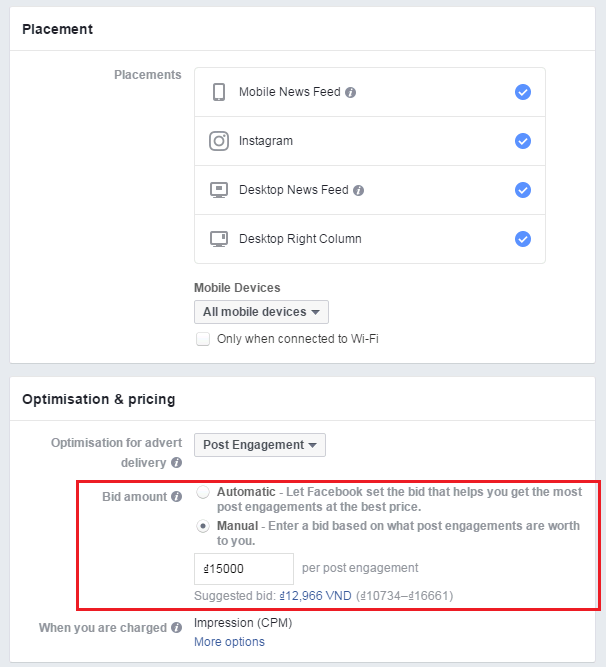
Second step: Facebook estimation. Afterwards, its recommended to compare the Facebook estimations you get on the Advert Set configuration (this info is showed only in Manual configurations) .

Bidding
Estimations are shown in local currencies. In this case, our account is based in Vietnam Dongs – VND


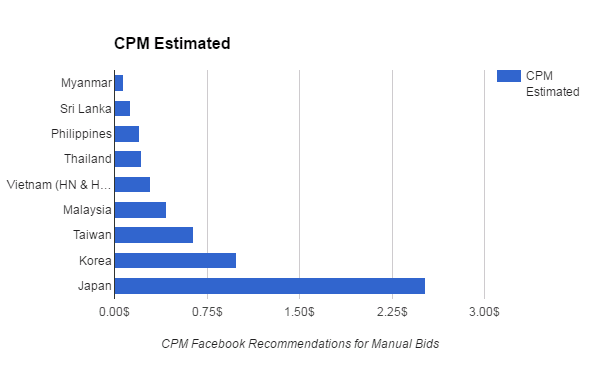
After doing the set-up for all these countries, here it is the ‘Facebook CPM suggestion’ for this pool of countries:

Facebook CPM estimation
As you can imagine, we decided to quit Japan

Third step: testing phase.  Now we are ready to make some real estimations to our client to manage their expectations. In order to be a real test we ensured the following items:

  • Same set-up: All the campaigns were optimized to obtain a low cost-engagement. Recommended approach for branding purposes.
  • Same visuals.
  • Same audience indicators (simple audience  set-ups are recommended in testing campaigns, once you get experience in that market, you can use this numbers as a reference to optimize)
  • Same wordings: content. To be a 100% accurate benchmark we should have used local languages, however our time limitation forced us to do everything in English. The campaign was purely B2B – target audience were fragrance distributors with capacity to import and/or distribute large amounts of perfume- and these profiles tend to have a medium/high level of English.

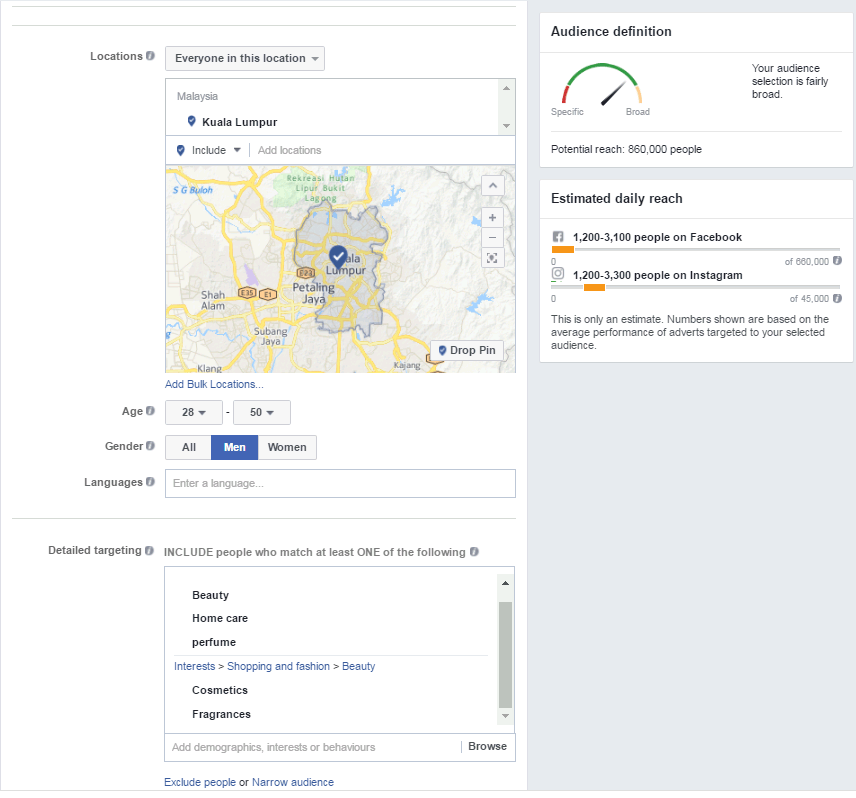
Target Audience
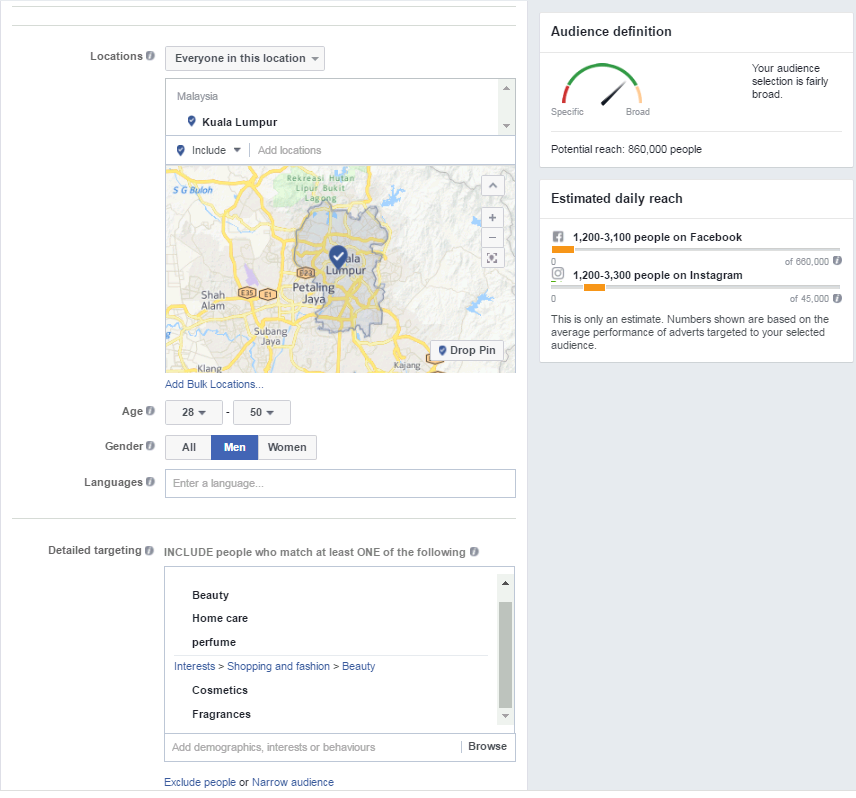
Audience set-up for Malaysia

So, after 6 days and $600 among the 8 countries, here we have the results:


CPC.png

Overall, the Cost per engagement was much lower than expected, which was good news in terms of branding. The CPC performance was obviously bad due to the engagement-optimized set up, however I recognized that I expected better values at Vietnam and Myanmar. Taiwan surprisingly high and Malaysia very high too considering how English friendly this country is and our previous campaigns experience.

NOTE: This campaign was done with one single post. The post was exactly the same for every country (image and content). Text was typed in English which should carry out lower costs for English friendly countries like Malaysia, Sri Lanka or Philippines

The campaign belongs to Chemarome, a multinational fragrance producer that operates in Europe, Asia, Middle east and Central Africa.


CPC VS CPM – How to pass from one to the other?

Most ocpc-vs-cpmf publishers and PPC services based their pricing rates on CPM,  for example, the New York Times banner services starts at an $8.00 plus additional targeting layers. However, our digital marketing plans are mostly CPC (or CPA) oriented… given that, a common question is how do I pass from CPM to CPC?
Let’s see an easy example of how to compare CPC and CPM services using Facebook Ads:
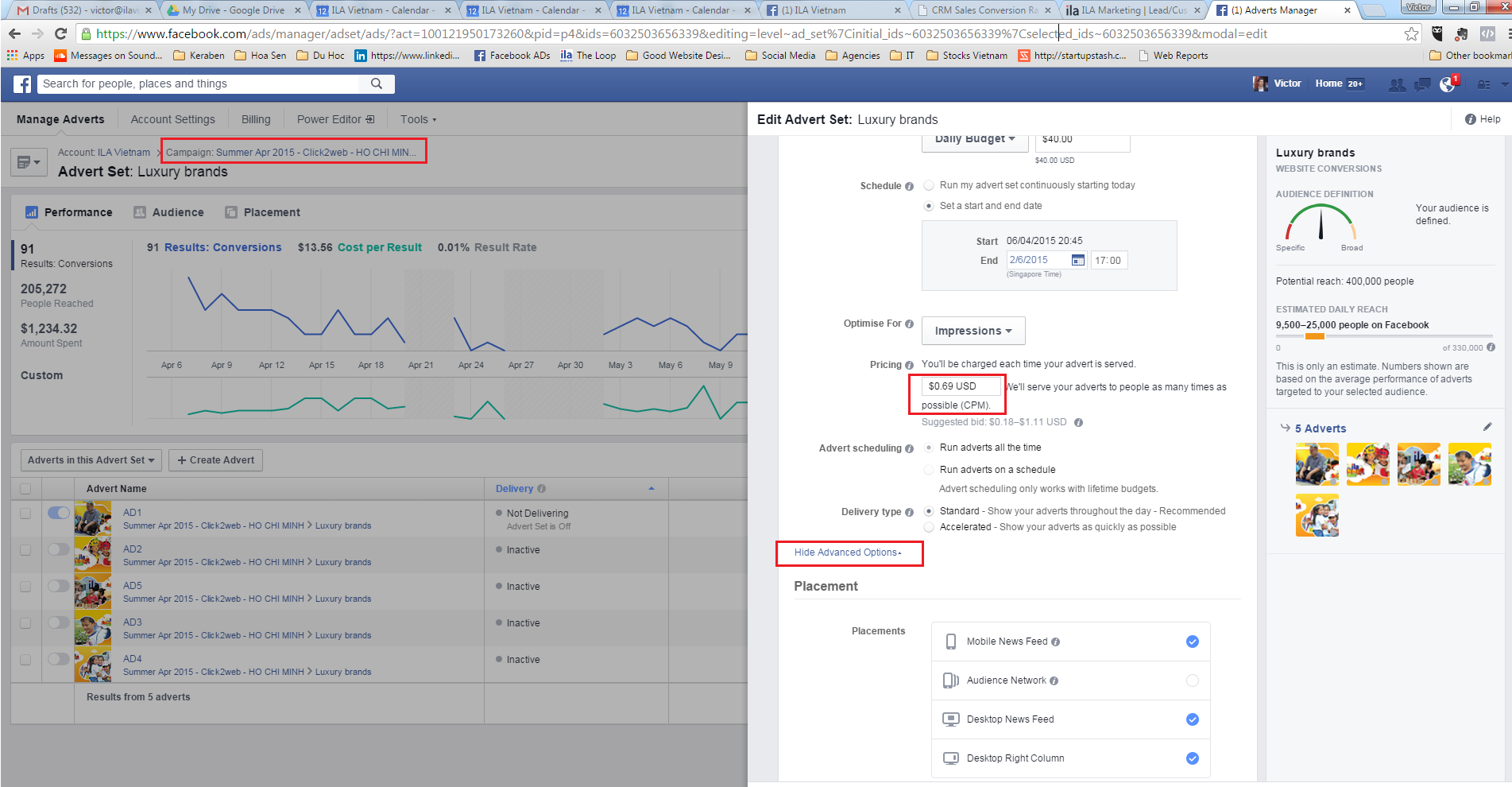
1. First of all, lets set the CPM ads option at some of our ads: Open (or create) any Facebook campaign you have already active on your Facebook ads panel

2. Move into (or create a new) advert set. Once there, click edit (pencil logo – first of the top right corner logos).3. Afterwards, click on “Show advanced options”

4. Then, change the pricing option to “Optimized per impressions” (usually this field is set as “optimized per clicks” as default)
5. After this, you will see a proposed price, in my case CPM – 0.69 USD. Which means that I will have to pay 0.69 USD per 1,000 impressions

CPM Example
CPM Example

5. Considering that my CTR on this campaign goes from 0.5% to 2%, it means:
CTR 0.5% -> 1,000 impressions X 0.5 / 100 = 5 clicks
CPM = 0.69 USD, it means I will have 5 clicks per 0.69 USD, in other words, a CPC of 0.69/5 = 0.13 USD
CTR 2% -> 1,000 impressions X 2 / 100 = 2o clicks
CPM=0.69 USD I will get 20 clicks, in other words, a CPC of 0.69/20 = 0.03
On average, I can expect to get clicks from $0.13 to $0.03, which is very good actually.
Given this, you may think… what happens if this is the first time I use this service and I have no reference of my CTR? In that case… just ask  it! Publishers technical teams should have an average CTR of their banners which can make you guess the number of clicks you will have with a certain budget

What does CPC, CPA, CTR or CPI really mean? Digital Marketing Acronyms

Most digital marketing beginners believe they fully understand what CPC, CPA, CTR and other terms mean. But after running a few campaigns and comparing your results in analytics, you often realize that numbers don’t quite match expectations. That’s when you discover how important it is to master these basics.

Core Search Terms: SEM, SEO, SERP, PPC

You may struggle to find two websites that agree on the exact scope of these terms. Below are practical, widely used definitions:

  • SEM – Search Engine Marketing: All marketing that drives traffic from search engines, including SEO and paid search. In practice, many practitioners use SEM to refer specifically to paid search campaigns.
  • SERP – Search Engine Results Page: The list of results a search engine shows after a query.
  • PPC – Pay-Per-Click: An ad model where you pay when a user clicks your ad. PPC covers search ads as well as many social and display formats.
  • SEO – Search Engine Optimization: The process of improving the quantity and quality of traffic from search engines. To learn more about the key institutions of the industry, please check  Moz (perhaps counts with some of the top voices of the industry writing on their blog), Ahrefs (one of the most active communities, their Facebook groups are amazing), and Semrush. some of the very first advanced tool, and still now is a great option to make assessments of your in-page.
  • GEO (Generative Engine Optimization): process or strategy of optimizing digital content specifically for generative AI engines and platforms like ChatGPT, Google Gemini, and Microsoft Copilot. Unlike traditional SEO, which focuses on getting clicks by ranking on a SERP, the goal of GEO is to have your content be the source that a generative AI selects and cites directly in its answer to a user’s query.
  • AEO (Answer Engine Optimisation): AEO is the practice of creating and optimising content to be easily found and used by “answer engines,” which are search tools or AI systems designed to provide direct answers to user questions rather than a list of links. AEO is about being the “answer” rather than just a “link” in the search results. I guess each marketer would have its own opinion, but to me at least, AEO is an activity, perhaps the most important one, among your GEO strategy activities.

If you want to learn more bout the vanguard of SEO/GEO, read this new article where we explain the next revolution.

Key Cost Models: CPC, CPA, CPM, CPI, CPV

  • CPC – Cost Per Click: What you pay for each click. Note that ad platforms count clicks, while analytics tools often report sessions; these numbers rarely match exactly.
  • CPA – Cost Per Acquisition: Cost for a defined action (purchase, registration, download, etc.). Related metrics:
    • CPL – Cost Per Lead
    • CPI – Cost Per Install (commonly used in app marketing)
    • CPV – Cost Per View (often used in video)
  • CPM – Cost Per Mille (thousand impressions): A standard billing unit for display/video inventory. Always evaluate CPM alongside CTR, reach, and conversion metrics.
  • ROAS – Return on Ad Spend: Revenue generated divided by ad spend; a go-to efficiency metric.

CTR, CR, Reach & Impressions

  • CTR – Click-through Rate: The percentage of viewers who click your ad.
  • CR – Conversion Rate: The percentage of users who complete a desired action out of those who hit the prior step (e.g., clicks → leads).
  • Reach vs Impressions: Reach is the number of unique users exposed to your ad; Impressions is total displays (including multiple views by the same user).

Modern Analytics & Funnel Metrics

  • GA4 – Google Analytics 4: Event-based tracking with a stronger focus on users and events than legacy session models.
  • CAC – Customer Acquisition Cost
  • LTV – Lifetime Value
  • MQL / SQL – Marketing Qualified Lead / Sales Qualified Lead
  • DSP – Demand-Side Platform (programmatic buying)
  • OTT / CTV – Over-the-Top / Connected TV
  • AI & LLMs: Tools and techniques (e.g., large language models) used for personalization, content generation, and prediction.

Where to Run SEM: Major Ad Engines

Paid search and shopping campaigns can be executed across multiple engines and markets:

Tip: Platform choice depends on where your audience searches and the regulatory/cultural context of each market.

Reference CPM Ranges (Display, Social, Video, CTV)

CPM costs vary widely by inventory quality, targeting, format, seasonality, and market. The following ballpark ranges are commonly cited:

  • Display (open exchange/GDN-style): ~$2–$10 CPM
  • Social (Facebook/Instagram, etc.): ~$6–$15 CPM
  • Online Video / YouTube: ~$10–$30 CPM
  • Connected TV (CTV): ~$20–$40 CPM

Use ranges as directional guidance only. Always validate with your own campaigns and current publisher quotes.

Practical Tools & Learning Resources

Final Thoughts

Understanding these acronyms isn’t just about jargon—it’s about making smarter decisions. Whether you’re optimizing for CPC, tracking CPA, or analyzing CTR, align each metric with a clear business goal. Bookmark this glossary and revisit it regularly!