Facebook & Google In-House Ads Accounts: How to improve media buying Transparency

During the last weeks I had to explain this issue several times, so I realized I should write a new Blog post to save time in future meetings 😀

With this article I pretend to introduce the big value that in-house accounts can provide to every small and medium company. Overall it will help to:

  • Increase transparency
  • Maximize investment
  • Boost performance.

I will based my article on the Facebook and Google accounts as these two ads platforms allow you to invest in media on Facebook, Instagram, Google Search, YouTube, G-Mail, Maps and GDN however we can extend this to any other traffic / media buying platform that offers a client panel.

Ok…. So, what is the problem? Why is there an overpricing on Facebook and Google media purchases? How is the current situation?

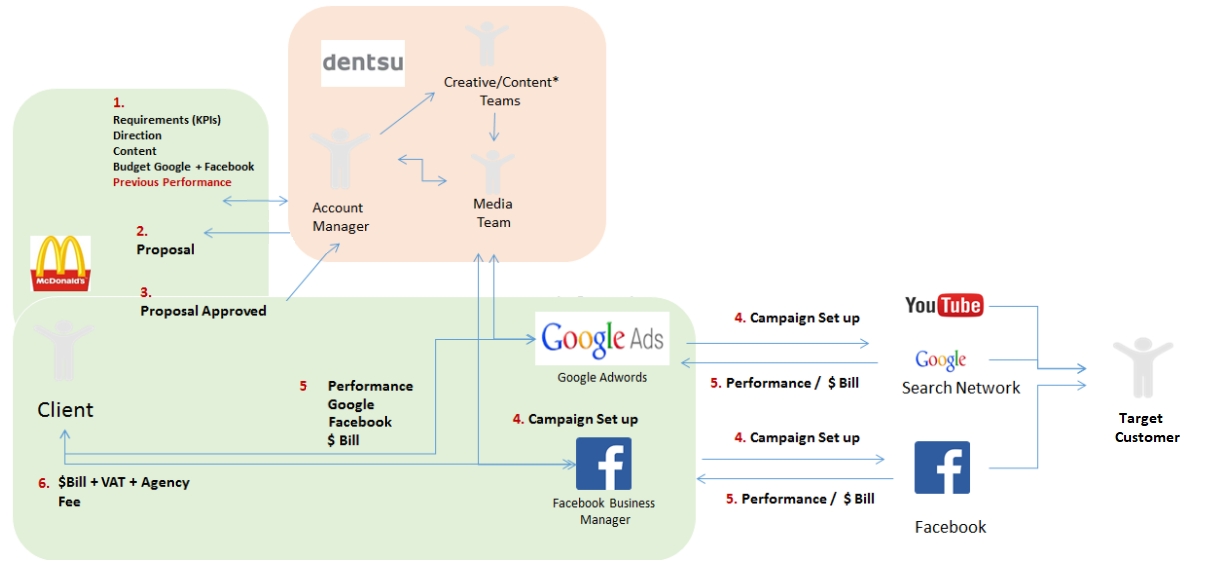
The chart below could be a good intro of the scenario. Let me go step by step:

Blog Visuals

Agency Accounts management

Let’s say that Mc. Donald’s has a brand new product that wants to boost and asks their Digital Agency (lets say…. Ogilvy, Leo Burnett, Dentsu or other digital group) to run a campaign in Facebook, YouTube and Facebook. For the example I will chose Dentsu due to the recent scandal commented to by the Financial Times they had in Japan for similar practices.

Long story short, the key problems starts when the Vendor proposal doesn’t provide:

  • Final performance of Clicks (CPC) / Engagements (Cos per engagement) gaps* based on Facebook/Google Ads estimations or variable costs. Instead of that, Vendors tend to propose fix Unit Cost (cost per click, cost per engagement, etc…) that most of the times are three to four times higher than they are actually paying to Facebook on average.
  • Access to the client to their Facebook / Google Ads accounts
  • Support to their clients to create their own accounts

At this point, some of you may think:

  1. Why should they provide a gap? – Most of the big digital publishers (Facebook, Google, Yahoo!…. do not have fix pricing lists but complex bidding systems (click her for further info)
  2. Why they bill 3-4 times the price they pay to Google/Facebook?

I may be defending the devil but it is true that there are several reasons to behave in that way like:

  • As a back-up in case they fail in their estimation.
  • As a back-up to spend less time in optimization/set ups.
  • Media budgets are usually 20% – 50% of the total costs. Big agencies charge big fees in creativity and content direction that cover media overspending.
  • To earn more money – Good agencies. Good optimization teams master their jobs in order to boost the gap from the ‘Unit Cost’ accepted by the client and the price they finally pay to the publishers
  • To ease quotations and boost long term plans.

Given this point, the agency (usually) finishes the quotation with a unit cost a way higher than the market price.

  • The agency delivers a proposal:
  • The Client approves: Let’s go!
  • The Agency uses their own accounts to work with the publishers:
  • Facebook Business Manager Account to pay Facebook for Facebook ads, Instagram Ads, etc…
  • Google Adwords Account to pay Google for ‘Google Search Network, GDN, YouTube Ads, etc…

Facebook and Google deliver ‘performance report’ and ‘bills’ (this is the key) to the Agency, not the client. Afterwards the Agency sends back the invoice but they (almost never) include the Facebook or Google Invoice…. In other words… The client has no clue of how much money the agency paid for the services!!!!

This is a big problem because Mc. Donald’s actually cannot request Facebook how much money the agency spent on the campaign:

  • Facebook client is Dentsu, not Mc. Donalds’s.
  • Facebook has no liability of giving any explanation to Mc. Donald’s.
  • Facebook is not allowed to display any data of Dentsu account without their approval.

Damnnn, how can Mc. Donald’s solve this issue:
Ask Dentsu to grant you access to their account: agencies may reject this option claiming that these accounts have data of other clients they do not want to share

In-house accounts.

By having in-house accounts Clients get the full control of how much money is spent in Facebook. Given this point, Clients have two options to run campaigns:

  1. Let the Agency use their account: By granting advertising permissions to the agencies, Clients can monitor the performance and the budget spent by the vendors. On top of that, they can access to the detailed performance information and develop digital know-how of the industry for future plans
  2. 100% In-house campaigns: Clients can run campaigns by themselves without agency intermediaries, which usually saves the ‘agency fees’ plus the VAT costs. Recommended only if the ‘head of digital’ has a strong background and extended experience

What does CPC, CPA, CTR or CPI really mean? Digital Marketing Acronyms

Most digital marketing beginners believe they fully understand what CPC, CPA, CTR and other terms mean. But after running a few campaigns and comparing your results in analytics, you often realize that numbers don’t quite match expectations. That’s when you discover how important it is to master these basics.

Core Search Terms: SEM, SEO, SERP, PPC

You may struggle to find two websites that agree on the exact scope of these terms. Below are practical, widely used definitions:

  • SEM – Search Engine Marketing: All marketing that drives traffic from search engines, including SEO and paid search. In practice, many practitioners use SEM to refer specifically to paid search campaigns.
  • SERP – Search Engine Results Page: The list of results a search engine shows after a query.
  • PPC – Pay-Per-Click: An ad model where you pay when a user clicks your ad. PPC covers search ads as well as many social and display formats.
  • SEO – Search Engine Optimization: The process of improving the quantity and quality of traffic from search engines. To learn more about the key institutions of the industry, please check  Moz (perhaps counts with some of the top voices of the industry writing on their blog), Ahrefs (one of the most active communities, their Facebook groups are amazing), and Semrush. some of the very first advanced tool, and still now is a great option to make assessments of your in-page.
  • GEO (Generative Engine Optimization): process or strategy of optimizing digital content specifically for generative AI engines and platforms like ChatGPT, Google Gemini, and Microsoft Copilot. Unlike traditional SEO, which focuses on getting clicks by ranking on a SERP, the goal of GEO is to have your content be the source that a generative AI selects and cites directly in its answer to a user’s query.
  • AEO (Answer Engine Optimisation): AEO is the practice of creating and optimising content to be easily found and used by “answer engines,” which are search tools or AI systems designed to provide direct answers to user questions rather than a list of links. AEO is about being the “answer” rather than just a “link” in the search results. I guess each marketer would have its own opinion, but to me at least, AEO is an activity, perhaps the most important one, among your GEO strategy activities.

If you want to learn more bout the vanguard of SEO/GEO, read this new article where we explain the next revolution.

Key Cost Models: CPC, CPA, CPM, CPI, CPV

  • CPC – Cost Per Click: What you pay for each click. Note that ad platforms count clicks, while analytics tools often report sessions; these numbers rarely match exactly.
  • CPA – Cost Per Acquisition: Cost for a defined action (purchase, registration, download, etc.). Related metrics:
    • CPL – Cost Per Lead
    • CPI – Cost Per Install (commonly used in app marketing)
    • CPV – Cost Per View (often used in video)
  • CPM – Cost Per Mille (thousand impressions): A standard billing unit for display/video inventory. Always evaluate CPM alongside CTR, reach, and conversion metrics.
  • ROAS – Return on Ad Spend: Revenue generated divided by ad spend; a go-to efficiency metric.

CTR, CR, Reach & Impressions

  • CTR – Click-through Rate: The percentage of viewers who click your ad.
  • CR – Conversion Rate: The percentage of users who complete a desired action out of those who hit the prior step (e.g., clicks → leads).
  • Reach vs Impressions: Reach is the number of unique users exposed to your ad; Impressions is total displays (including multiple views by the same user).

Modern Analytics & Funnel Metrics

  • GA4 – Google Analytics 4: Event-based tracking with a stronger focus on users and events than legacy session models.
  • CAC – Customer Acquisition Cost
  • LTV – Lifetime Value
  • MQL / SQL – Marketing Qualified Lead / Sales Qualified Lead
  • DSP – Demand-Side Platform (programmatic buying)
  • OTT / CTV – Over-the-Top / Connected TV
  • AI & LLMs: Tools and techniques (e.g., large language models) used for personalization, content generation, and prediction.

Where to Run SEM: Major Ad Engines

Paid search and shopping campaigns can be executed across multiple engines and markets:

Tip: Platform choice depends on where your audience searches and the regulatory/cultural context of each market.

Reference CPM Ranges (Display, Social, Video, CTV)

CPM costs vary widely by inventory quality, targeting, format, seasonality, and market. The following ballpark ranges are commonly cited:

  • Display (open exchange/GDN-style): ~$2–$10 CPM
  • Social (Facebook/Instagram, etc.): ~$6–$15 CPM
  • Online Video / YouTube: ~$10–$30 CPM
  • Connected TV (CTV): ~$20–$40 CPM

Use ranges as directional guidance only. Always validate with your own campaigns and current publisher quotes.

Practical Tools & Learning Resources

Final Thoughts

Understanding these acronyms isn’t just about jargon—it’s about making smarter decisions. Whether you’re optimizing for CPC, tracking CPA, or analyzing CTR, align each metric with a clear business goal. Bookmark this glossary and revisit it regularly!

Instagram Vs Facebook – Reach performance

During the last weeks, some working mates and friends keep asking me about Instagram. Some of them have already opened a profile for their business and post randomly, however they still see no big advantage compared to Facebook, where they spend most of their Digital Marketing time
This post tries to answer all these request and to introduce the real power of Instagram (Reach) and why we should not choose between Facebook or Instagram, but go for both of them

Performance oriented plans. Taget: Sales

If we are looking for Direct Sales, Web Registrations or in general for a performance oriented plan,  Facebook is still clearly ahead Instagram. Comparable to Google Ads, Facebook Ads is a mature traffic generation tool with strong customization tools and a big variety of options (click to website, conversion to website, post-engagement), however Facebook is getting too big, and they are cutting their Reach capacity.

Reach Engagement Oriented plans. Target: Branding 

However, not everything is Sales. Brands need to be permanently in touch with their audiences: introducing new trends, sending messages along with their vision & mission and engaging target users with content.  Here is where Instagram has clearly passed Facebook, specially after Facebook modified its algorithm to cut organic reach several times during 2014 and force brands to pay to keep their boost rates, reaching a point of “organic death” according to many marketers

starbucksLet’s have a look to some examples of big brands to understand the difference. We can see how Facebook profiles with much larger communities have very low reach & engagement compared to their Instagram profiles with a lower amount of followers
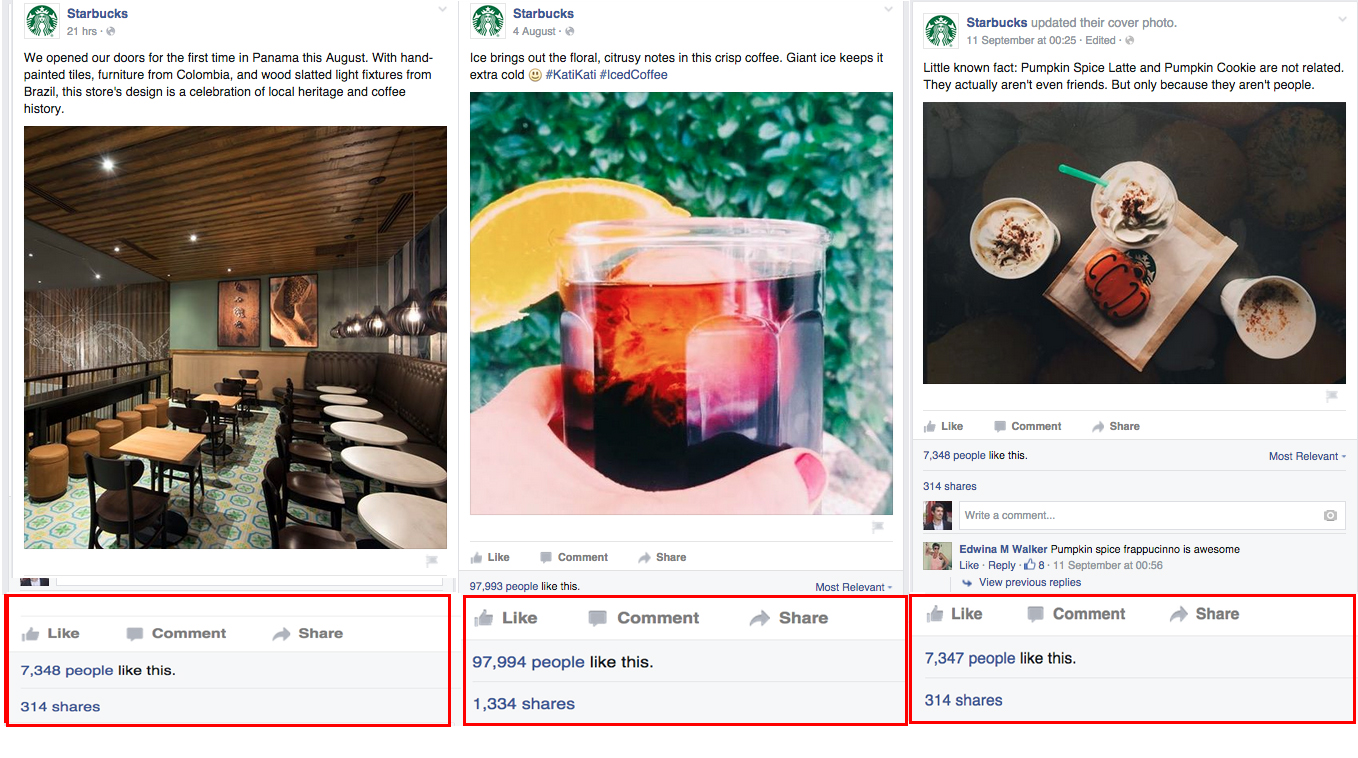
Let’s say Starbucks, if we compared the engagement (amount of likes, shares and comments) of the last 3 Facebook post (Starbucks fan page has 35+million fans) with the latest 3 Instagram posts (Starbucks Instagram counts with 5.7 million followers) we see:

Facebook Engagement: 116,009  people

Instagram: 551,193 people

Starbucks Facebook Starbucks Instagram

Which means, that Instagram provided 5 times more engagement with a 7 times lower community. 

If we compared the last couple post, the difference is even greater with almost an almost 25 times largest engagement.

Facebook post – New store in Panama (12 September, 21hr after post): 6,876

Instagram Post – New store in Panama (12 September, 13hr after post): 179,379.

This happens not only to Starbucks, if you compare other big brands in different industries like Zara Facebook Zara VS Istagram Zara or even in Sports with the last 3 post of Man. United Facebook (243,040) against its Instagram pal (473,363 engaged people) more than double with 11 times less followers (6 million Instagram against 65 million in Facebook)

Why Instagram is not Facebook yet?

So, why people are not using Instagram instead of Facebook. There’re several reasons of why we have such a massive differences:

  1. Facebook ads as a product, is far more developed and mature than Instagram:
    1. In terms of markets: (not present at dozens of big markets), allowing marketers to drive traffic in a more effective way
    2. In terms of revenues: Facebook and Instagram, as marketing solutions, are in different production stages. We could say that Facebook is present with 7.8 billion USD in revenues during the first 6 months of 2015 only, compared to the 0.30 billion USD Instagram target (26 times higher), and Instagram is the future with a revenues target of 2.81 billion USD in 2 years .
    3. Expansion difficulties: due to a worse ads product and because of being a mobile platform, to grow in Instagram is always slower than Facebook.
    4. In terms of users: Facebook number of users is 5 times larger than Instagram
Social Media Users comparison 2015

Conclusion

As an experienced digital marketing professional, I do recommend to keep both networks:

  1. Facebook: for performance oriented plans using their Facebook Ads
  2. Instagram: for brand oriented plans (and thinking in another tool to expand performance oriented plans in the future)